
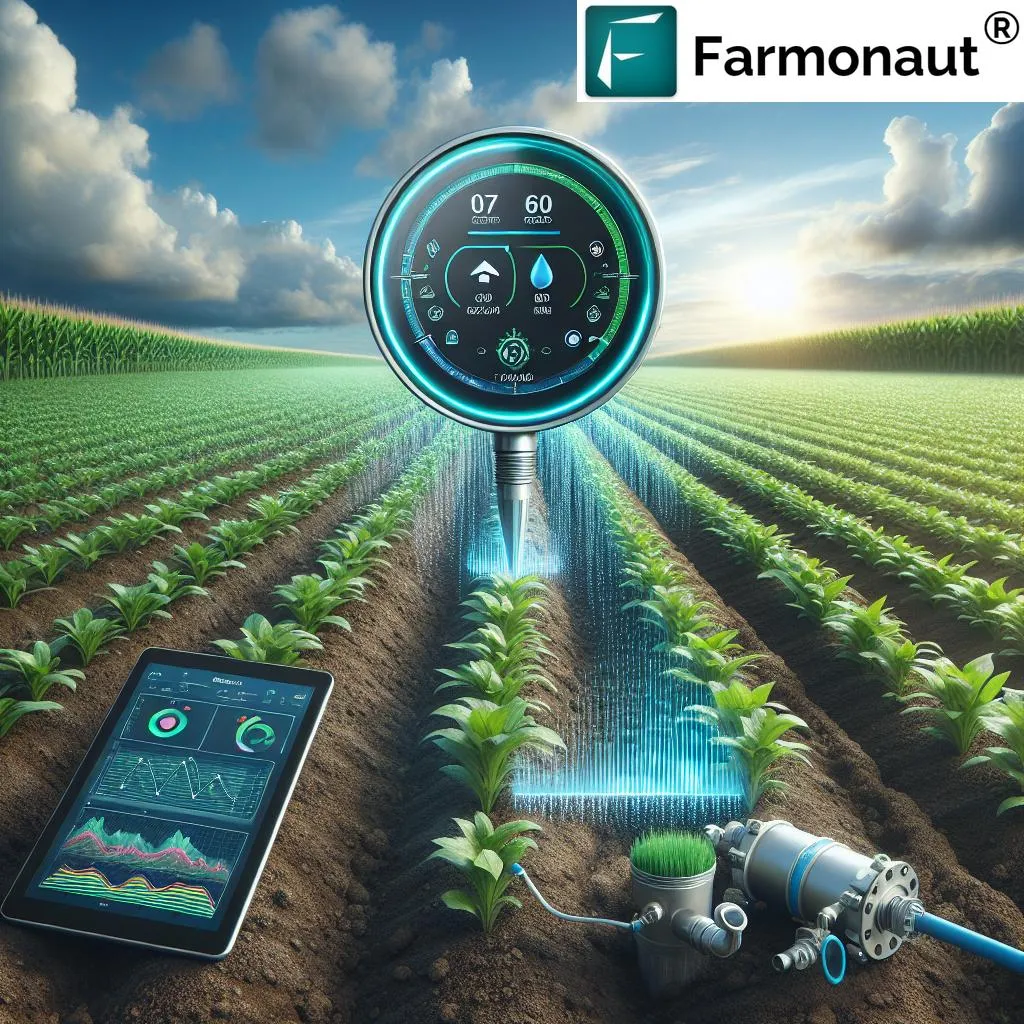
In the heart of precision agriculture, a new study is making waves by tackling a longstanding challenge in soil moisture sensing. Accurate soil water content (SWC) measurement is crucial for climate modeling, irrigation management, and crop yield prediction. However, current sensors that rely on dielectric permittivity often fall short due to site-specific soil variations. This is where the work of Muhammad Awais, a researcher from the Department of Electrical Engineering at Henan Agricultural University, comes into play. His recent paper, published in the Ain Shams Engineering Journal, sheds light on the necessity of soil-specific calibration for improving the accuracy of soil moisture sensors.
Soil’s dielectric permittivity, a measure of how it interacts with electromagnetic fields, is influenced by factors like texture, composition, and salinity. These variations can lead to significant errors in SWC estimation, affecting everything from irrigation decisions to hydrological models. “Without appropriate calibration, we’re essentially flying blind,” Awais explains. “The relationship between dielectric permittivity and soil water content isn’t universal. It’s like trying to fit a square peg into a round hole if you don’t account for these site-specific factors.”
The study systematically outlines various calibration methodologies for different soil types, describing the dependencies and discrepancies in using dielectric properties for SWC measurement. It reviews models that overcome these limitations, ranging from empirical approaches to physically-based dielectric mixing models. The research also explores future directions, highlighting the potential of emerging technologies like hyperspectral imaging to complement traditional dielectric sensing techniques.
The commercial impacts of this research are substantial. For the agriculture sector, improved soil moisture sensing means more accurate irrigation scheduling, leading to water savings and increased crop yields. It also enables better data-driven decision-making for farmers and agronomists. “Imagine a future where sensors can provide real-time, highly accurate soil moisture data tailored to specific fields,” Awais envisions. “This could revolutionize precision agriculture, making it more efficient and sustainable.”
The study also points towards next-generation methods, suggesting that the integration of multiple sensing technologies could enhance the accuracy and reliability of soil moisture monitoring. This could open up new avenues for research and development in the field of agricultural technology.
As the world grapples with climate change and the need for sustainable agriculture, the work of Awais and his colleagues offers a promising path forward. By enhancing the accuracy of soil moisture sensing, we can take a significant step towards more efficient water use and improved crop productivity. The journey towards precision agriculture is ongoing, but with each new discovery, we inch closer to a future where technology and agriculture intertwine to feed the world sustainably.