
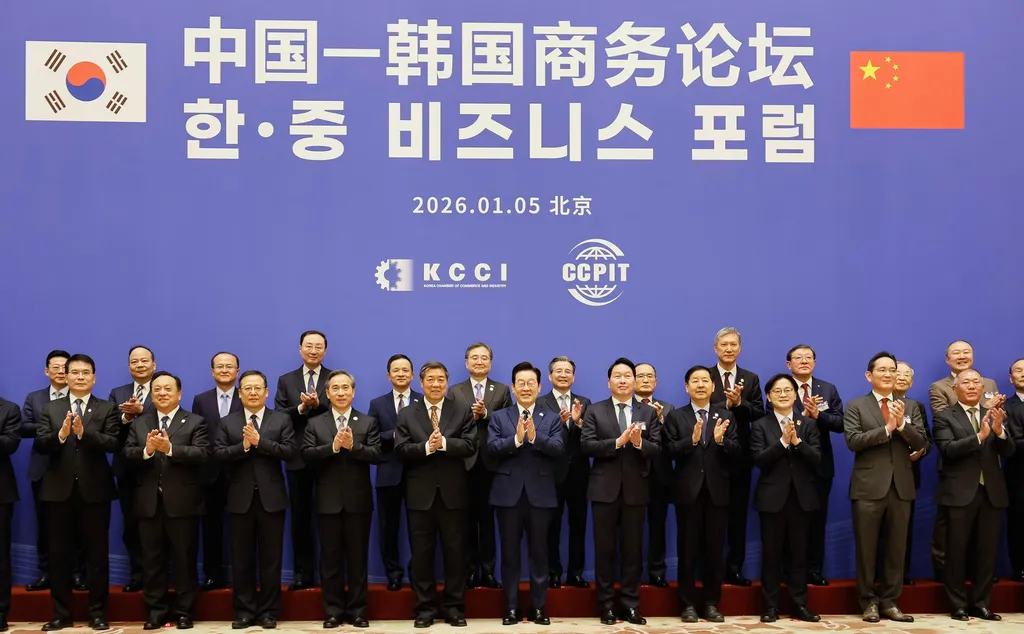
In a significant move to bolster economic ties, Korean and Chinese companies have signed nine memorandums of understanding (MOUs) for cooperation in consumer goods, content, and supply chain sectors. This development marks the state visit of Korean President Lee Jae Myung to China, underscoring the growing partnership between the two nations.
The MOUs were inked during a Korea-China business forum held in Beijing, setting the stage for summit talks between President Lee and Chinese President Xi Jinping. The event was graced by top executives from major companies and economic organizations from both countries, including Samsung Electronics Chairman Lee Jae-yong, Hyundai Motor Group Chair Euisun Chung, SK Group Chairman Chey Tae-won, and LG Group Chairman Koo Kwang-mo from Korea. Notable Chinese attendees included Ren Hongbin, chairman of the China Council for the Promotion of International Trade, and Fu Qijun, chairman of Sinopec Group.
In the consumer goods sector, Korea’s retail giant Shinsegae Group signed an initial agreement with China’s Alibaba International to export Korean consumer goods through Alibaba’s online platform. This collaboration is expected to significantly boost the presence of Korean products in the Chinese market. Additionally, three other MOUs were signed between Korea’s fishcake maker Samjinfood, agriculture technology firm Farmstaff, and biotech company PharmaResearch, and their respective Chinese partners. These agreements aim to expand the export of Korean food and beauty products to China.
The content and gaming industries also saw significant collaboration, with three MOUs signed for the joint development of cultural content related to K-pop, entertainment, and film. This initiative is poised to enhance cultural exchange and foster innovation in the entertainment sector.
In the supply chain sector, Korean future mobility company SWM reached an initial agreement with Lenovo, a global IT company based in China, to jointly develop a computing platform for the commercialization of level 4 autonomous vehicles. Furthermore, Keosung, a Korean manufacturer, and China’s BF Nano Tech agreed to jointly construct a materials factory for power generation and water treatment. These partnerships are expected to drive technological advancements and strengthen industrial cooperation.
Industry Minister Kim Jung-kwan highlighted the continued momentum for economic and trade cooperation between Korea and China. He emphasized efforts to help Korean companies expand their foothold in the Chinese market, noting that President Lee Jae Myung’s state visit to China comes just two months after a meeting between the countries’ leaders during the Asia-Pacific Economic Cooperation (APEC) summit in Gyeongju, North Gyeongsang Province.
The implications of these MOUs are far-reaching, promising to enhance bilateral trade, foster technological innovation, and deepen cultural exchange. As Korea and China continue to strengthen their economic ties, these agreements are set to pave the way for new opportunities and collaborations in various sectors.