
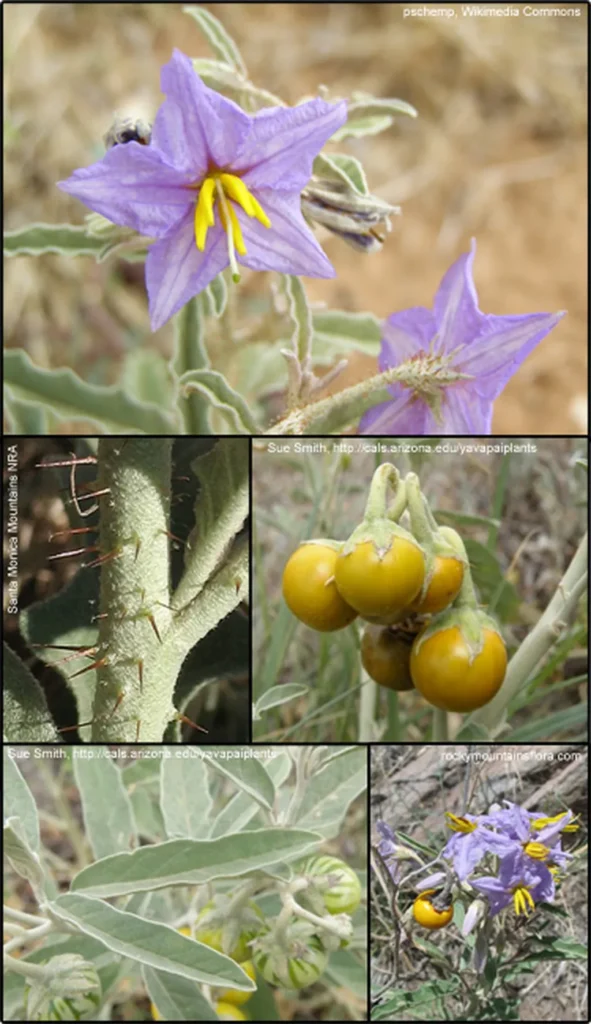
In the ongoing battle against invasive weeds, scientists are turning to nature’s own arsenal for solutions. A recent study published in the *Journal of Sustainable Agriculture and Environment* has shed light on two promising candidates for biological control of the noxious weed silverleaf nightshade (Solanum elaeagnifolium Cav., or SLN). The research, led by Samikshya Subedi from the Department of Soil, Water, and Climate at the University of Minnesota Twin Cities, explores the potential of two North American insects, Leptinotarsa texana and Gargaphia arizonica, as biocontrol agents.
Silverleaf nightshade is a perennial weed that has spread across the globe, posing significant challenges to agriculture. Traditional methods of control, such as chemical herbicides and mechanical removal, can be costly and environmentally damaging. Biological control offers a more sustainable alternative, using natural predators to target and manage weed populations.
The study combined field and laboratory experiments to assess the host ranges and feeding behaviors of L. texana and G. arizonica. Over two years, researchers planted SLN alongside eggplant and potato, close relatives of the weed, to observe the insects’ feeding preferences. They found that L. texana fed on both SLN and eggplant, causing similar damage to both, but showed no interest in potato. In contrast, G. arizonica was exclusively observed feeding on SLN in the field.
In laboratory no-choice experiments, where the insects had no alternative host plants, G. arizonica did feed on eggplant and potato. However, the survival rates and feeding damage were significantly lower on these non-target plants compared to SLN. “This suggests that the biosecurity risks associated with G. arizonica are relatively low,” said Subedi, highlighting the insect’s potential as a safe and effective biocontrol agent.
The findings have significant implications for the agriculture sector. Biological control methods can reduce reliance on chemical herbicides, lowering costs and environmental impact. Moreover, targeted biocontrol can help preserve beneficial plant species, promoting biodiversity and ecosystem health.
Looking ahead, this research could pave the way for further exploration of G. arizonica as a biocontrol agent. “Our results indicate that G. arizonica shows promise as a potential biological control agent for SLN, especially when compared to other candidates like L. texana,” Subedi explained. Future studies could delve deeper into the insect’s life cycle, reproductive rates, and environmental tolerances to assess its suitability for large-scale deployment.
As the agriculture industry grapples with the challenges posed by invasive weeds, innovative solutions like biological control offer hope. By harnessing the power of natural predators, farmers can achieve more sustainable and effective weed management, safeguarding their crops and the environment for future generations.