
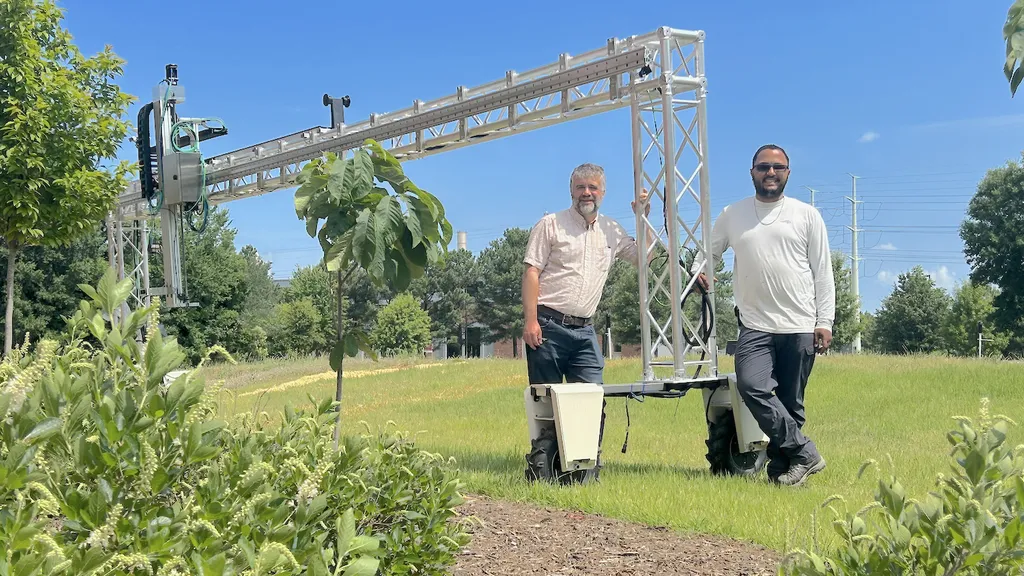
In the ever-evolving landscape of agricultural technology, a beacon of innovation shines through the work of Riley Lawson and colleagues from the Department of Biological and Agricultural Engineering at North Carolina State University. Their recent review, published in the *Journal of Sustainable Agriculture and Environment*, delves into the transformative potential of biosensor advancements for tackling critical agricultural and environmental challenges.
Biosensors, often hailed as the unsung heroes of modern agriculture, are poised to revolutionize how farmers monitor and manage their crops. These sophisticated devices provide real-time, field-deployable diagnostics for a myriad of applications, from soil nutrient analysis to crop disease detection and water quality protection. “Biosensors offer a proactive approach to agriculture, enabling farmers to make data-driven decisions that enhance productivity and sustainability,” Lawson explains.
The review highlights recent strides in enzymatic, lab-on-a-chip, and fiber optic-based biosensors, particularly those enhanced with nanomaterials and designed for disposable use. These advancements pave the way for in situ deployment, allowing for continuous and accurate monitoring of agricultural ecosystems. “The integration of biosensors with artificial intelligence and Internet of Things networks can support data-driven decision-making, fostering sustainable agricultural and environmental resilience,” Lawson adds.
The commercial implications for the agriculture sector are substantial. Biosensors can significantly reduce the need for labor-intensive and costly manual testing, thereby lowering operational costs and increasing efficiency. Moreover, the ability to detect diseases and nutrient deficiencies in real-time can prevent crop losses and optimize resource use, ultimately boosting yields and profitability.
However, the path to widespread adoption is not without its hurdles. Ensuring prolonged shelf life, calibration uniformity, field robustness, quality control, and ease of use remains a challenge. Lawson emphasizes the need for interdisciplinary innovation and user-centered design to overcome these barriers. “By addressing these issues, we can unlock the full potential of biosensors as scalable, field-ready tools for sustainable agriculture and robust environmental management.”
As we look to the future, the integration of biosensors into agricultural practices holds immense promise. The work of Lawson and colleagues not only sheds light on the current state of biosensor technology but also sets the stage for future developments that could redefine the agricultural landscape. In an era where sustainability and efficiency are paramount, biosensors stand as a testament to the power of innovation in driving progress.