
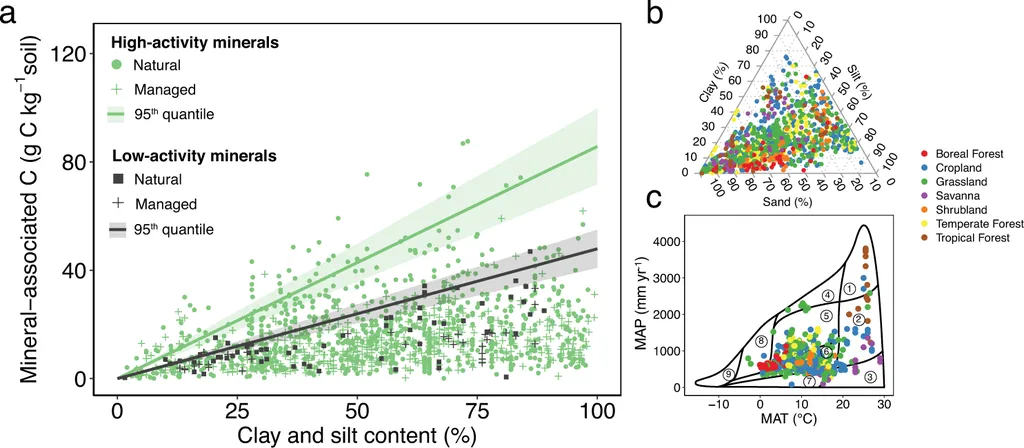
In the quest to understand how climate change will affect our planet, scientists are turning their attention to the ground beneath our feet. A new study, published in *Earth System Science Data*, has compiled a global dataset of soil organic carbon (SOC) mineralization in response to temperature changes, shedding light on a critical but often overlooked aspect of climate projections. The research, led by S. Zhang from the State Key Laboratory of Soil Pollution Control and Safety at Zhejiang University, highlights significant gaps in current experimental designs and calls for more accurate modeling to better predict future climate scenarios.
Soil organic carbon is a major source of atmospheric CO₂, and its mineralization— the process by which microbes break down organic matter—plays a pivotal role in climate-carbon feedbacks. “Understanding how SOC mineralization responds to temperature is essential for improving climate projections,” Zhang explains. The dataset compiled by Zhang and colleagues reveals that 84% of samples come from surface soils (0–30 cm), and 50% of incubations lasted fewer than 50 days. Incubation temperatures ranged from -10 to 60°C, with temperature intervals used to estimate temperature sensitivity (Q₁₀) spanning 2–40°C. Notably, 81% of Q₁₀ estimates were based on intervals exceeding 5°C.
One of the most striking findings is that in 61% of cases, the lower incubation temperature for Q₁₀ estimation differed from the mean annual temperature at the sampling site by more than 5°C. This mismatch indicates a significant deviation from in situ conditions, which could lead to inaccurate climate models. “Our analysis highlights critical gaps in current experimental designs, particularly the underrepresentation of subsoils (>30 cm) and the use of temperature ranges that deviate from field conditions,” Zhang notes.
The study also evaluated the ability of 16 temperature response functions used in 69 land surface and/or carbon models to capture SOC mineralization patterns. Most models failed to reproduce empirical temperature responses, especially at higher temperatures, although multi-term exponential functions showed relatively better performance. This finding underscores the need for improved model parameterizations to enhance SOC feedback projections under future climate scenarios.
For the agriculture sector, the implications are profound. Accurate predictions of SOC mineralization can help farmers and agronomists make informed decisions about soil management practices, such as crop rotation, cover cropping, and the application of organic amendments. These practices can enhance soil carbon sequestration, improve soil health, and ultimately increase agricultural productivity. “By coupling our dataset with a two-pool carbon model, we found that external environmental constraints and the intrinsic temperature response similarly influence the temperature sensitivity of SOC mineralization at the global scale,” Zhang explains. “Their relative importance varies across ecosystem types, which is crucial for tailoring soil management strategies to specific regions.”
The dataset is publicly available, providing a valuable resource for researchers, policymakers, and agricultural practitioners. As climate change continues to impact global ecosystems, the need for accurate and reliable data becomes increasingly urgent. This research not only highlights the gaps in current knowledge but also paves the way for more precise and effective climate projections, ultimately benefiting the agriculture sector and beyond.