
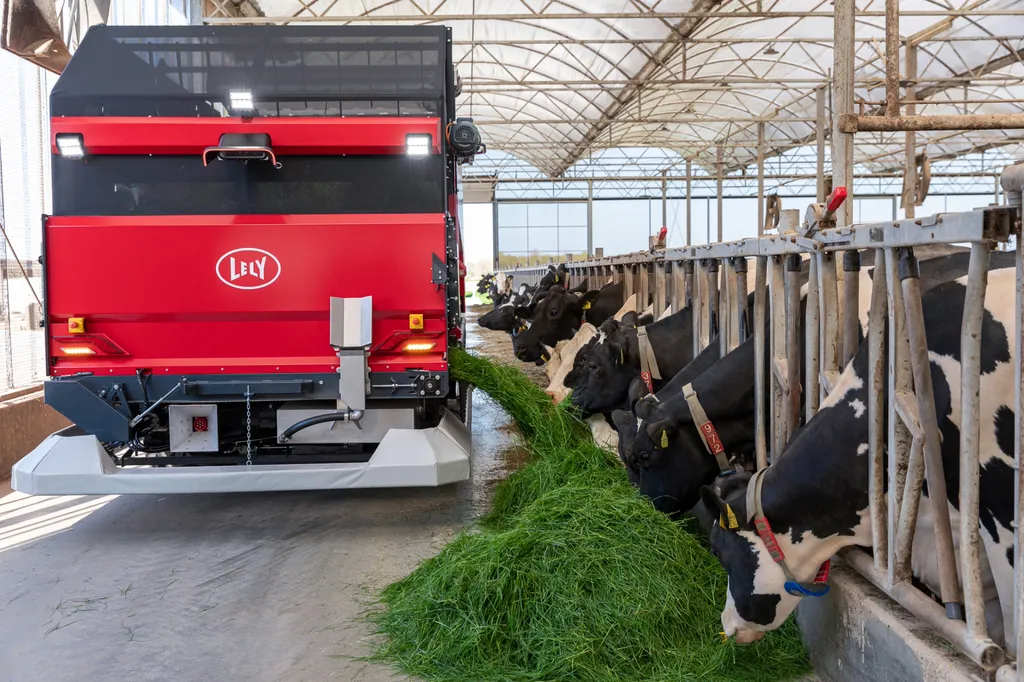
After five years of development and rigorous testing, Lely’s fully electric Exos robot has made its way into practical use on 25 dairy farms, predominantly in the Netherlands. This innovative machine, designed for mowing, collecting, and delivering fresh grass directly to the feed fence without any manual labour, has been the subject of a recent discussion with five early adopters by Future Farming. The insights gathered from these farmers provide a comprehensive overview of the robot’s performance in real-world scenarios.
Lely Exos was first introduced in 2020 as part of the ‘Yellow Revolution’, a designation Lely uses for new concepts that are not yet commercially available. The concept garnered significant attention and accolades, including the innovation award at EuroTier in 2022. By 2023, the machine was operational and drawing considerable interest from the agricultural community.
Edwin Honings, Head of Exos at Lely International, expressed his satisfaction with the progress. “The rollout in the field is gaining momentum. There are now 25 farms where Exos is operating. We have learned a great deal and have also adjusted and further developed certain aspects. This has mainly been in the area of software. As a result, with a team that monitors the systems 24/7, we can resolve more than 80% of any alerts remotely. The machine itself has changed very little technically.”
The primary function of Lely Exos is the autonomous feeding of fresh grass, significantly reducing the labour required. However, planning remains crucial. Farmers need to decide which plots to mow, the desired grass height, and the combinations of plots to create a balanced ration. The Lely Exos programme allows farmers to create a plot playlist based on the set ration, enabling the robot to follow a defined sequence of plots throughout the day.
The mowing robot autonomously harvests grass from pre-entered plots, with the sequence adjustable as needed. Utilizing GPS for navigation, Exos can load up to 1,400 kg of grass, making it a versatile tool for modern dairy farms.
Honings highlighted several advantages of Exos compared to conventional summer zero-grazing methods, which typically involve a tractor with a front mower and a trailing forage wagon. “Our machine is much lighter. This reduces dependence on soil bearing capacity. As a result, you can start zero-grazing much earlier in the season and also continue for longer.” The machine’s design ensures that only two wheels at a time run in the same track, further minimizing soil compaction.
Lely continues to refine mowing patterns and field routes. For instance, in wet conditions, the robot can operate in a crab steering pattern, reducing the frequency of driving over the headlands and leaving small triangular patches uncut. This adaptability ensures that the machine can operate efficiently under various conditions.
Technical specifications of the Lely Exos include a double cutter bar 1.80 meters wide, a bunker capacity of 900 to 1,400 kg of fresh grass, and a fully electric drive with a 17.28 kWh battery. The machine’s undercarriage consists of four 520/50 R17 wheels at 1.0 bar, with a total weight of 3,600 kg empty and up to 5,000 kg when loaded with grass. The robot also features a 200-litre fertiliser storage capacity.
The fully electric operation of the robot is a significant advancement. The battery, which is recharged after each mowing and feeding run, allows the robot to harvest grass from plots up to 1.5 to 2 kilometres away. The machine’s design includes two rigid axles that articulate in the centre, with all wheels individually and electrically driven. This setup enables precise manoeuvring and efficient operation.
Safety is a paramount concern, with the robot equipped with two cameras at the front and rear that recognize people and objects. The machine stops immediately if an obstacle is detected, ensuring the safety of both the livestock and farm personnel.
One of the standout features of the Lely Exos is its ability to apply fertiliser immediately behind the cutter bar. Farmers can determine the application rate per hectare through the management programme, with the machine capable of applying up to 50 kg of nitrogen per hectare. This feature not only enhances the efficiency of the mowing process but also contributes to sustainable farming practices.
Commissioning the Exos robot is relatively straightforward, requiring minimal physical adjustments on the farmyard. The charging station and fertiliser station need to be set up, and barn doors may need automation. The robot operates using ultrasonic sensors in the barn and GPS outdoors, with all plots, buildings, and obstacles mapped using Lely’s drawing software.
Farmers can track the robot via an