
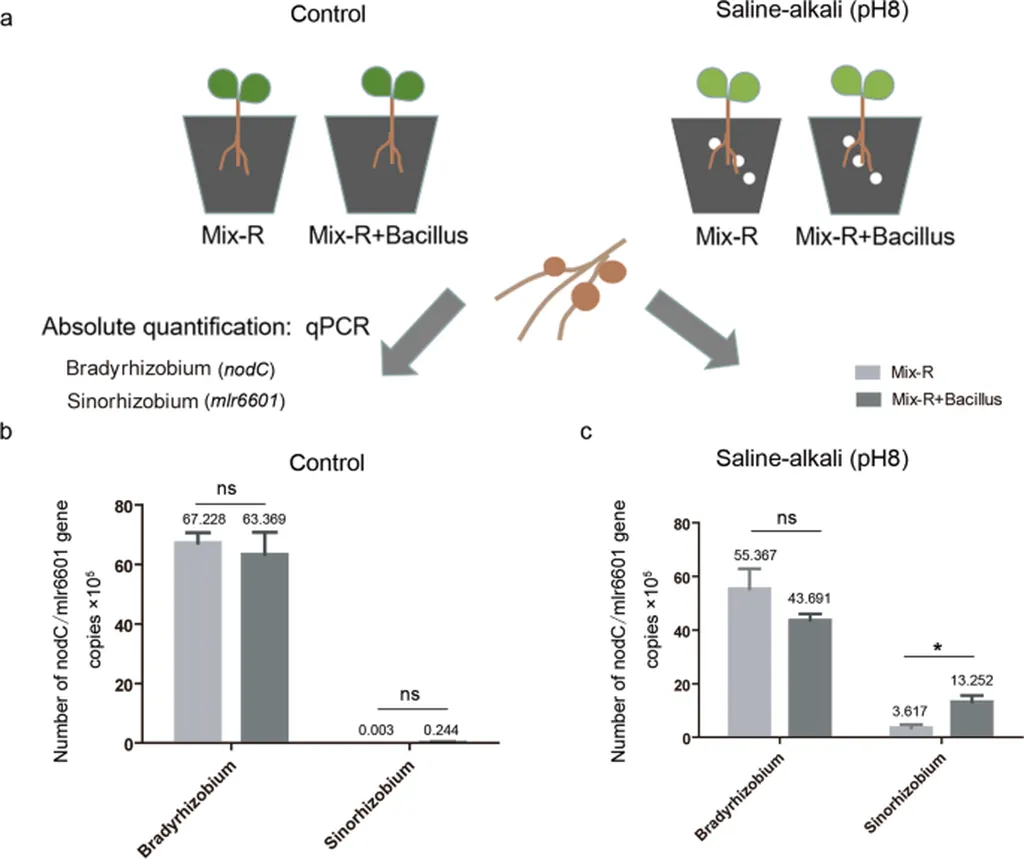
In the quest for sustainable agriculture, scientists are turning to the microscopic world for solutions, and a recent study published in *Microbiology Spectrum* offers promising insights. Researchers led by Minqing Huang from the College of Agriculture at South China Agricultural University have uncovered how a specific strain of bacteria, Rhizobium subbaraonis TY15, can enhance soybean growth and disease resistance by altering the microbial communities in the rhizosphere—the soil region influenced by plant roots.
The study isolated and identified 193 bacterial strains from the soybean rhizosphere, narrowing down to 19 representative strains through genetic diversity analysis. Among these, Rhizobium subbaraonis TY15 stood out due to its dominant presence and plant growth-promoting traits. “This strain not only promotes soybean growth but also modulates the rhizosphere microbial community in a way that increases beneficial bacteria and suppresses harmful pathogens,” explains Huang.
The findings reveal that Rhizobium subbaraonis TY15 significantly boosts the abundance of beneficial genera like Bacillus and Rhizobium, which are known for their plant growth-promoting activities. This modulation of the microbial community enhances nutrient mobilization and pathogen resistance, offering a sustainable alternative to chemical fertilizers and pesticides.
The commercial implications for the agriculture sector are substantial. As the demand for sustainable and eco-friendly farming practices grows, microbial biofertilizers like Rhizobium subbaraonis TY15 could play a pivotal role in reducing reliance on chemical inputs. “By leveraging the natural interactions between plants and beneficial microbes, we can develop targeted biofertilizers that improve crop resilience and nutrient efficiency,” says Huang.
The study also highlights the limitations of conventional screening methods in capturing the full potential of microbial inoculants. By integrating culture-dependent isolation with high-throughput sequencing, the researchers were able to uncover the unique benefits of Rhizobium subbaraonis TY15, paving the way for precision microbial consortia design.
This research not only advances our understanding of plant-microbe interactions but also sets the stage for developing more effective and sustainable biofertilizers. As the agriculture sector continues to face challenges related to climate change and food security, the insights from this study offer a promising path forward. By optimizing plant-microbe interactions, farmers can enhance crop productivity while minimizing environmental impact, ultimately contributing to a more sustainable future for agriculture.