
In the ever-evolving landscape of agricultural technology, a groundbreaking study has emerged that promises to revolutionize tobacco crop mapping using satellite imagery. Published in the IEEE Journal of Selected Topics in Applied Earth Observations and Remote Sensing, the research introduces TSP-Former, a novel deep learning framework that leverages satellite image time series to capture the unique growth dynamics of tobacco plants. This innovation addresses longstanding challenges in the agriculture sector, offering a more accurate and robust method for spatial mapping that could significantly impact agricultural planning and public health regulation.
The study, led by Huaming Gao from the State Key Laboratory of Remote Sensing and Digital Earth at the Chinese Academy of Sciences, introduces the tobacco spectral-phenological variable (TSP), a key innovation that captures change rates in the Red Edge-2 spectral band during peak growth. This variable serves as a crop-specific prior knowledge for model guidance, enabling the TSP-Former to adaptively fuse spectral information with phenological priors. “By incorporating these phenological priors, we can capture the unique growth patterns of tobacco plants, which is crucial for accurate mapping,” explains Gao.
The TSP-Former architecture includes two novel modules: the central prior attention module (CPAM) and the NDVI-enhanced temporal decoder (NDTD). The CPAM adaptively fuses spectral information with phenological priors, while the NDTD reinforces temporal learning by emphasizing phenologically critical stages using NDVI-weighted sequences. This approach ensures that the model can handle regional differences in planting practices and single-date spectral similarities among crops, which have historically limited the generalizability of existing methods.
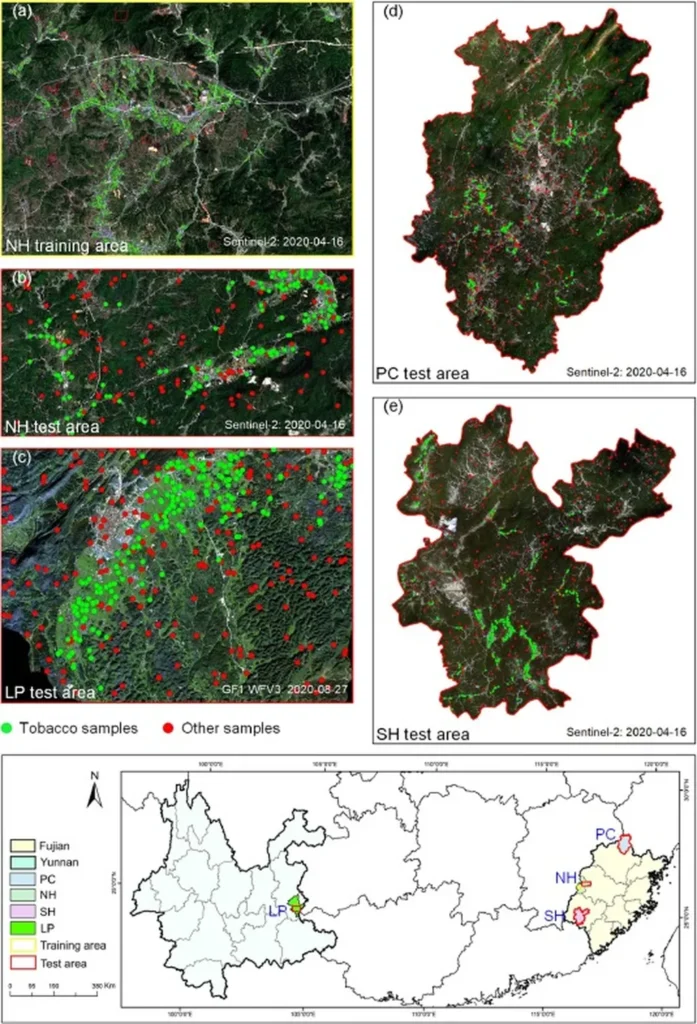
The results of the study are impressive. Extensive experiments across four major tobacco regions using Sentinel-2 imagery demonstrate the method’s superior cross-regional robustness. TSP-Former achieved an average weighted F1-score of 87.1% and an overall accuracy of 85.9%, significantly outperforming random forest and competing deep learning approaches. Notably, in regions characterized by substantial phenological shifts, the proposed method surpassed the emerging remote sensing foundation model, AlphaEarth, by over 15% in accuracy.
The commercial implications of this research are substantial. Accurate and timely tobacco mapping is essential for agricultural planning, enabling farmers to optimize planting strategies and improve crop yields. Additionally, precise mapping supports public health regulation by providing data that can inform policies related to tobacco production and consumption. “This technology has the potential to transform the way we monitor and manage tobacco crops, leading to more efficient and sustainable agricultural practices,” says Gao.
The integration of phenological priors into temporal deep models represents a significant advancement in the field of remote sensing. This approach not only enhances the accuracy of crop mapping but also ensures robustness and transferability across heterogeneous and data-constrained regions. As the agriculture sector continues to embrace technological innovations, the TSP-Former framework could pave the way for scalable agricultural monitoring and policy development.
In conclusion, the research led by Huaming Gao and published in the IEEE Journal of Selected Topics in Applied Earth Observations and Remote Sensing highlights the transformative potential of integrating phenological priors into deep learning models for crop mapping. This innovation offers a robust and accurate solution for tobacco mapping, with far-reaching implications for the agriculture sector and public health regulation. As the field of agritech continues to evolve, the TSP-Former framework stands as a testament to the power of combining remote sensing with advanced machine learning techniques.