
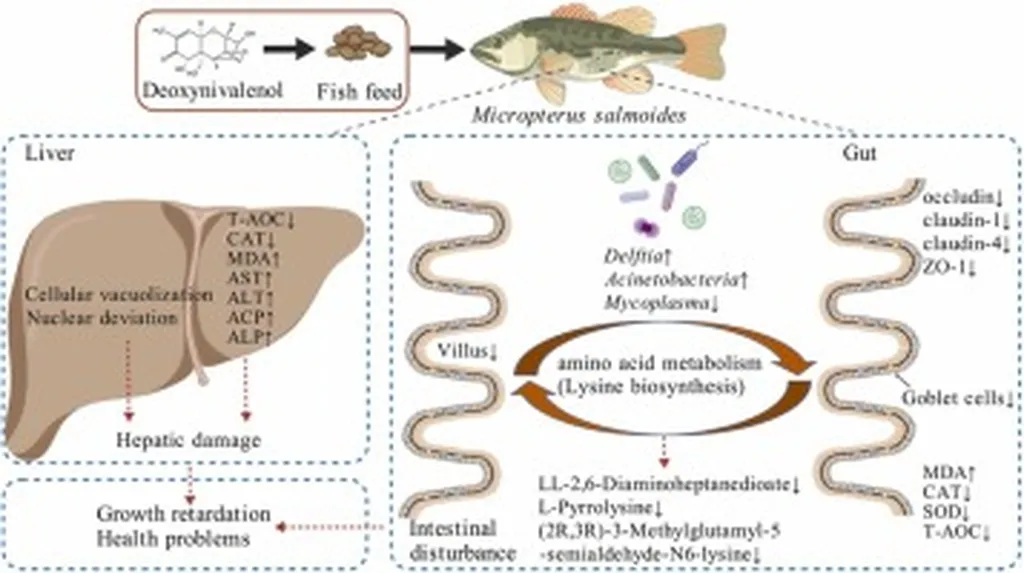
In the quest to enhance aquaculture productivity and sustainability, researchers have turned their attention to gut health, a critical factor in fish well-being and growth. A recent study published in *Aquaculture Reports* sheds light on the potential benefits of emodin, a natural compound found in plants, for improving intestinal health in juvenile largemouth bass (*Micropterus salmoides*). The findings could have significant implications for the aquaculture industry, offering a promising avenue for optimizing fish health and performance.
The study, led by Zhenxin Zhao from the College of Fisheries at Guangdong Ocean University and the Institute of Fisheries at Guizhou Academy of Agricultural Sciences, investigated the effects of dietary emodin supplementation on various aspects of intestinal health in largemouth bass. The research team fed 540 fish different doses of emodin over two months, ranging from 0 to 4000 mg per kilogram of diet.
The results were striking. Emodin supplementation at levels between 500 and 2000 mg/kg significantly improved intestinal villus height, villus width, and goblet cell count compared to the control group. These morphological changes suggest enhanced nutrient absorption and overall gut health. However, the highest dose of 4000 mg/kg had the opposite effect, reducing villus height and goblet cell count, indicating a potential threshold for beneficial effects.
“Our findings demonstrate that emodin can positively influence intestinal morphology and digestive function in largemouth bass, but the dose is crucial,” Zhao explained. “Too much can be counterproductive, highlighting the need for careful optimization in dietary supplements.”
The study also revealed that emodin supplementation enhanced the activities of several digestive enzymes, including amylase, alkaline phosphatase, and lipase, particularly at the 1000 mg/kg dose. This suggests that emodin can boost the digestive capacity of largemouth bass, potentially leading to better growth and feed conversion rates.
One of the most intriguing aspects of the research was its impact on gut microbiota. Emodin supplementation altered the composition, diversity, and richness of the intestinal microbiota in a dose-dependent manner. Notably, the 1000 mg/kg dose decreased the abundance of potential pathogens like *Fusobacteriaceae* and *Vibrionaceae* while increasing the presence of beneficial bacteria such as *Rubrobacteriaceae* and *Lactobacillaceae*. This shift towards a healthier microbial community is likely to enhance the fish’s overall health and resistance to diseases.
“Modulating the gut microbiota is a key strategy for improving fish health and productivity,” Zhao noted. “Our results suggest that emodin could be a valuable tool in this regard, promoting a more favorable microbial balance in the intestines.”
The study also found that emodin supplementation improved the antioxidant and anti-inflammatory capacity of the intestines. The 1000 mg/kg dose elevated the expression of antioxidant enzymes like catalase, superoxide dismutase, and heme oxygenase-1, as well as the nuclear factor erythroid 2-related factor 2 (Nrf2), which plays a crucial role in protecting cells from oxidative stress. Additionally, the expression of pro-inflammatory cytokines interleukin-8 and tumor necrosis factor-alpha was reduced, indicating a potential anti-inflammatory effect.
These findings could have significant commercial impacts for the aquaculture sector. By optimizing gut health through emodin supplementation, farmers may be able to improve growth rates, feed efficiency, and disease resistance in largemouth bass and potentially other fish species. This could lead to more sustainable and profitable aquaculture practices, addressing some of the industry’s pressing challenges.
The research also opens up new avenues for exploring the use of natural compounds in aquaculture. As consumers increasingly demand sustainably and ethically produced seafood, the use of natural supplements like emodin could gain traction as a means to enhance fish health without relying on antibiotics or other synthetic compounds.
In conclusion, the study led by Zhenxin Zhao and published in *Aquaculture Reports* provides compelling evidence for the benefits of emodin supplementation in improving intestinal health in juvenile largemouth bass. The findings offer valuable insights for the aquaculture industry, highlighting the potential of natural compounds to enhance fish health and productivity. As the industry continues to seek sustainable and effective solutions, emodin and similar compounds may play an increasingly important role in shaping the future of aquaculture.