
In the face of climate change and water scarcity, farmers are increasingly seeking innovative solutions to protect their crops and ensure food security. A recent study published in *Plant Stress* offers a promising avenue for enhancing drought tolerance in canola, a vital oilseed crop, through the application of fulvic acid (FA), a naturally occurring biostimulant. The research, led by Mohammad Rahbari of BioLiNE® Corporation in Canada, sheds light on the biochemical mechanisms underlying FA’s protective effects, potentially revolutionizing drought management strategies in agriculture.
The study evaluated the impact of drought stress on canola (Brassica napus) and the efficacy of FA in mitigating drought-induced damage. Canola plants were subjected to four treatments: well-watered control, well-watered with FA, drought control, and drought with FA. The results were striking. FA application significantly improved root growth under drought conditions, a critical factor for water uptake and nutrient absorption. “The enhanced root development we observed in FA-treated plants suggests that fulvic acid could be a game-changer for farmers dealing with water scarcity,” Rahbari noted.
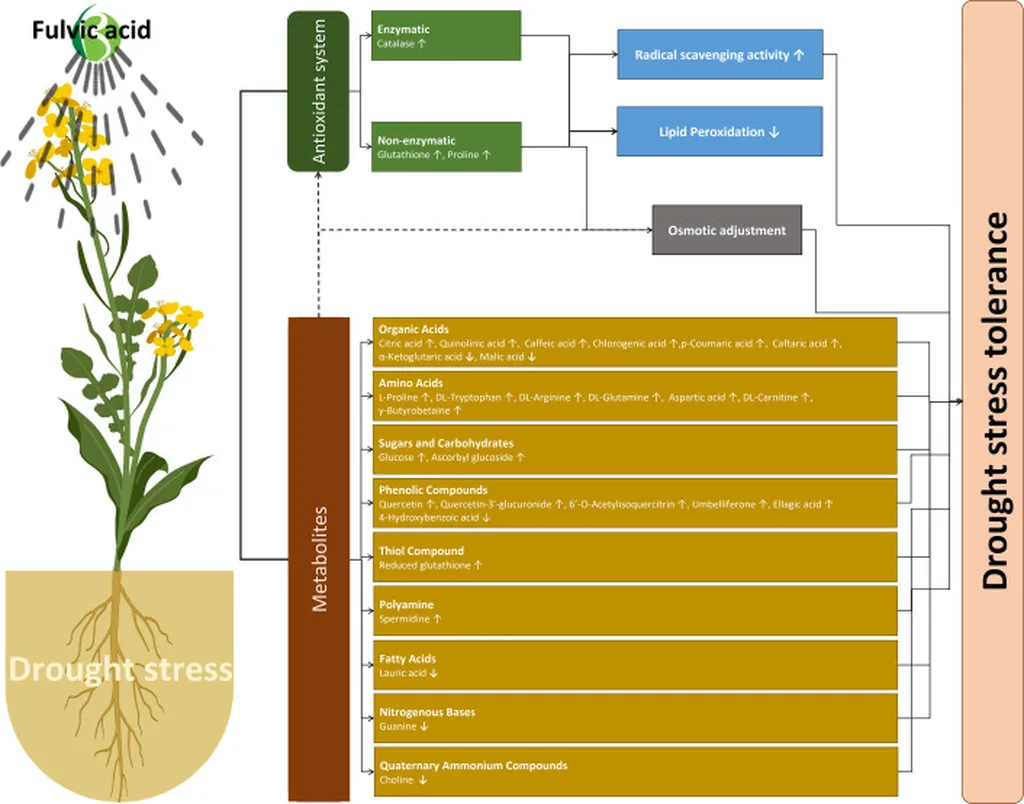
The research delved into the physiological and metabolic responses of canola plants, revealing that FA treatment led to increased levels of soluble protein, glutathione, and catalase activity. These compounds play pivotal roles in antioxidant defense and stress management. Drought stress typically increases radical scavenging activity and malondialdehyde (MDA), indicators of oxidative stress and lipid peroxidation. However, FA treatment further elevated radical scavenging activity and significantly reduced lipid peroxidation, demonstrating its potent antioxidant properties.
Proline accumulation, a marker of osmoprotection, was highest in drought-stressed plants treated with FA. This suggests that FA enhances the plant’s ability to maintain cellular turgor and protect its cellular structures under water-deficient conditions. Metabolomic profiling revealed that FA modulated central and secondary metabolism, increasing levels of stress-related metabolites such as proline, glucose, glutamine, phenolics (quercetin, ellagic acid), antioxidants, nitrogenous metabolites (trigonelline), and polyamines (spermidine). These metabolic shifts were associated with improved oxidative stress management and cellular resilience.
The commercial implications of this research are substantial. As droughts become more frequent and severe, farmers need effective, sustainable tools to protect their crops and maintain yields. Fulvic acid, derived from natural sources, offers a promising solution. Its ability to enhance root growth, antioxidant defenses, and osmoprotection can help farmers mitigate the adverse effects of drought stress, ensuring more stable and productive harvests.
Moreover, the study’s findings could pave the way for the development of new biostimulant formulations tailored to specific crops and stress conditions. “Understanding the biochemical pathways activated by fulvic acid allows us to design more targeted and effective agricultural interventions,” Rahbari explained. This could lead to a new generation of biostimulants that not only enhance drought tolerance but also improve overall crop health and productivity.
The research published in *Plant Stress*, led by Mohammad Rahbari of BioLiNE® Corporation, highlights the potential of fulvic acid as a powerful tool in the fight against drought stress. As the agricultural sector continues to grapple with the challenges posed by climate change, innovative solutions like FA offer hope for a more resilient and sustainable future. By harnessing the power of natural biostimulants, farmers can better adapt to changing environmental conditions and ensure food security for generations to come.