
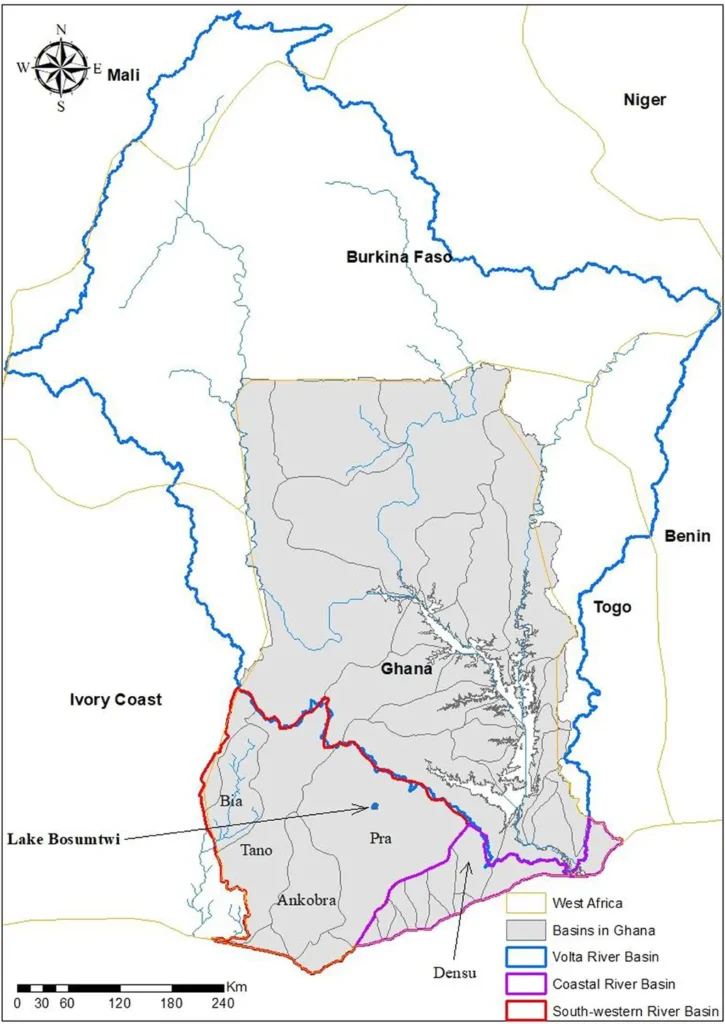
In the heart of Ghana, the Kulpawn River Basin (KRB) has long been a lifeline for rural communities, providing essential ecosystem services like water supply, agricultural support, and biodiversity conservation. However, a recent study published in ‘Regional Sustainability’ reveals that significant land use and land cover (LULC) changes over the past few decades are taking a toll on these vital services, with profound implications for the agriculture sector and local livelihoods.
Between 1995 and 2023, the KRB has seen a substantial shift in its landscape. Agricultural lands expanded by 14.14%, built-up areas by 15.17%, and light savannah forest by 8.73%, while dense savannah forest and water bodies declined by 25.71% and 20.00%, respectively. These changes have led to a notable decline in ecosystem service values (ESVs), dropping from 410.09×10⁸ USD/(hm2•a) in 1995 to 319.28×10⁸ USD/(hm2•a) in 2023.
The study, led by Osman Zakari from the Regional Water and Environmental Sanitation Centre at Kwame Nkrumah University of Science and Technology and the Environmental Protection Authority in Ghana, employed advanced techniques like the random forest algorithm to analyze Landsat images and the benefit transfer method to estimate ESVs. The research also gathered insights from local communities on the drivers of these ecosystem changes.
“The reduction in ESVs is primarily due to agricultural activities, expansion of built-up areas, population growth, and artisanal mining,” Zakari explained. “These activities have led to the degradation of land use and land cover, ultimately affecting the ecosystem services that rural communities rely on.”
For the agriculture sector, these findings are particularly concerning. The decline in water bodies and forest cover can lead to reduced water availability and increased soil erosion, both of which can severely impact crop yields and farm productivity. Moreover, the loss of biodiversity can disrupt pollination services, further threatening agricultural outputs.
The study underscores the urgent need for sustainable land use planning and ecosystem conservation strategies. “There is an urgent need to develop programs and strategies to mitigate and curtail the degradation of LULC and ESVs in the basin,” Zakari emphasized. “This will require collaborative efforts from policymakers, local communities, and other stakeholders.”
The research not only highlights the ecological vulnerability of the KRB but also offers valuable insights for future developments in the field. It calls for a more integrated approach to land use planning, one that balances agricultural expansion with ecosystem conservation. This could involve promoting sustainable farming practices, implementing reforestation programs, and enforcing stricter regulations on mining activities.
As the world grapples with the impacts of climate change and land degradation, studies like this one serve as a stark reminder of the need for sustainable practices. They also provide a roadmap for how we can protect our ecosystems while supporting rural livelihoods. The findings from the Kulpawn River Basin could serve as a model for other regions facing similar challenges, guiding them towards a more sustainable and resilient future.
In the end, the study is a call to action, urging us to rethink our relationship with the land and the ecosystems that support us. It’s a reminder that our future depends on the choices we make today, and that sustainable development is not just an option, but a necessity.