
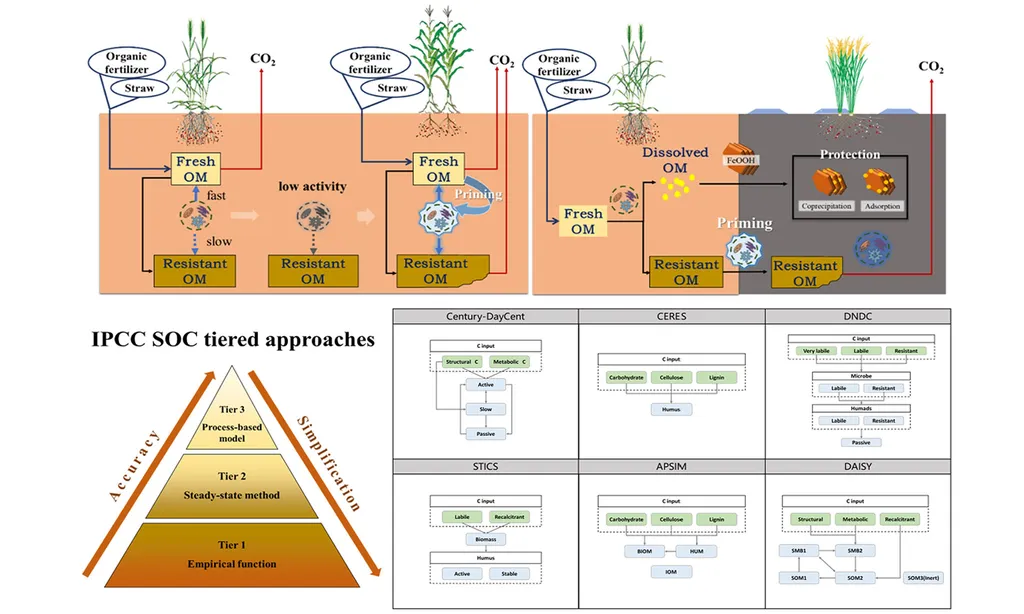
In the heart of Northeast China’s black soil region, a groundbreaking study is reshaping how we approach soil organic matter (SOM) estimation, a critical factor for food security and precision agriculture. The research, led by Mingchang Wang from the College of Geo-Exploration Science and Technology at Jilin University, and published in the journal Geoderma, introduces a novel cross-modal integration framework that combines the strengths of proximal hyperspectral and satellite spectral data.
Remote sensing technology has long been a game-changer in agriculture, enabling rapid and accurate data acquisition. However, the limitations of multispectral imagery’s spectral resolution and the scalability of proximal hyperspectral data have posed significant challenges. Wang’s study addresses these issues head-on by proposing a cross-modal modeling framework that integrates these two data sources, enhancing both spectral accuracy and spatial continuity.
The study’s lead author, Mingchang Wang, explains, “Our approach applies hyperspectral reconstruction technology to satellite data, effectively extending proximal hyperspectral observations into spatially continuous imagery. This balance between spectral accuracy and spatial continuity is crucial for large-scale, high-precision SOM estimation.”
The research also tackles the issue of SOM spatial heterogeneity by introducing a spatial similarity-based random forest (SS-RF) local modeling strategy. This innovative approach significantly improves estimation accuracy compared to traditional global models, increasing the coefficient of determination (R²) by 7.64%.
One of the study’s key findings is the impact of soil particle size on spectral reflectance and SOM estimation accuracy. The results showed that finer particle sizes (100 mesh, ≤0.15 mm) yielded the best performance, with an R² of 0.874. In contrast, the model constructed using field in-situ hyperspectral reconstructed imagery produced the lowest accuracy (R² = 0.730).
The commercial implications of this research are substantial. Accurate, large-scale SOM estimation is vital for precision agriculture, enabling farmers to optimize crop yields, reduce input costs, and minimize environmental impact. As Wang notes, “Our synergistic optimization approach, which combines spectral reconstruction, local modeling, and particle size standardization, provides new insights and technical support for high-precision SOM estimation at the regional scale.”
The study’s findings could pave the way for future developments in agritech, particularly in the realm of remote sensing and data integration. As the agriculture sector continues to embrace digital transformation, the demand for accurate, real-time data will only grow. This research offers a promising solution, demonstrating the potential of cross-modal integration and local modeling strategies to meet these evolving needs.
In an increasingly data-driven world, the ability to accurately estimate SOM at scale is a significant step forward for the agriculture sector. As the global population continues to grow, the pressure on farmers to produce more with less will only intensify. This research, led by Mingchang Wang and published in Geoderma, offers a glimpse into a future where technology and agriculture converge to create more sustainable, efficient, and productive farming practices.