
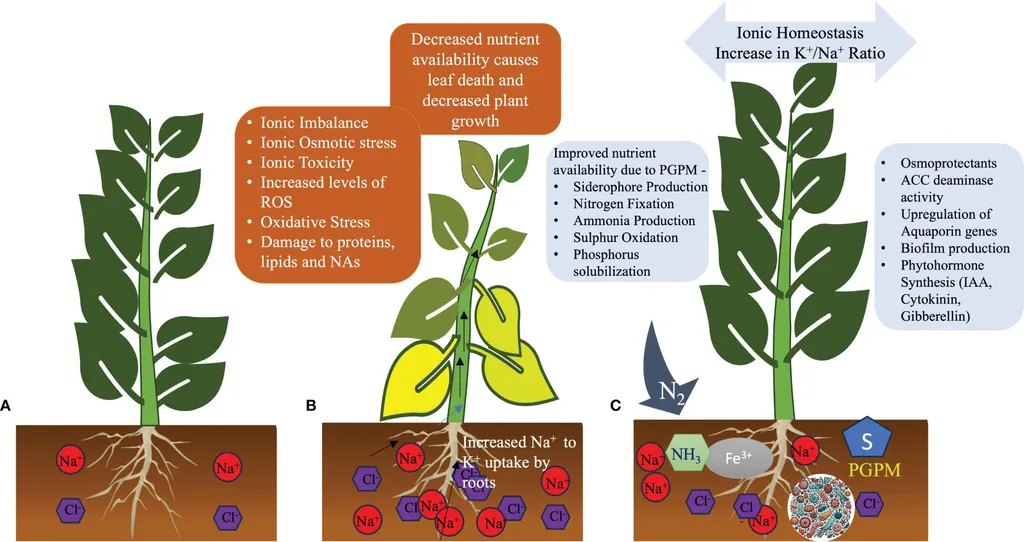
In the face of escalating soil salinization, a silent crisis is unfolding in agriculture, threatening crop productivity and food security. Yet, a glimmer of hope emerges from the intricate dance between plant genomes and the microscopic world in the soil. A recent review published in *Frontiers in Plant Science* sheds light on how plants and their rhizosphere microbial partners collaborate to combat salt stress, offering promising avenues for sustainable agriculture.
The review, led by Yi Ren from Nanjing Normal University, integrates cutting-edge research to unravel the complex interplay between plant genomes and the rhizosphere microbiome under salt stress. “Plants have evolved sophisticated genomic mechanisms to mitigate the adverse effects of salinity, but their resilience is significantly bolstered by dynamic interactions with rhizosphere microbial communities,” Ren explains.
Salt stress triggers a cascade of physiological damages in plants, including ionic imbalance, osmotic stress, and oxidative damage. However, plants have developed several genomic mechanisms to reduce these negative influences, which are further supported by dynamic interactions with rhizosphere microbial communities. The review highlights the pivotal role of plant-growth-promoting rhizobacteria (PGPR), arbuscular mycorrhizal fungi (AMF), and microbial volatiles in modulating gene expression and root architecture.
Notably, specific PGPR strains, such as Enterobacter sp. SA187 and Bacillus velezensis, have been shown to upregulate key stress-related genes and increase antioxidant enzyme activities, enhancing plant resilience under salinity. These microbes also influence stress signaling pathways, such as the SOS (Salt Overly Sensitive) and ABA (Abscisic Acid) pathways, which are crucial for plant survival in saline conditions.
The review also delves into the effect of root exudates on microbial communities. Under salt stress, plants alter their root exudation patterns, enriching beneficial microbial taxa like Sphingomonas and Streptomyces. Additionally, volatile compounds such as benzenoids and ketones contribute to systemic stress responses, further enhancing plant resilience.
Understanding these synergistic plant–microbe interactions provides a foundation for engineering salt-resilient crops and advancing sustainable agricultural practices in saline soils. The review discusses the application of synthetic microbial consortia and genome-scale strategies such as transcriptomics, GWAS (Genome-Wide Association Studies), and CRISPR (Clustered Regularly Interspaced Short Palindromic Repeats) technology.
The commercial implications for the agriculture sector are substantial. By harnessing the power of plant-microbe interactions, farmers could cultivate crops that are more resilient to salt stress, thereby increasing yields and ensuring food security in saline-affected regions. This research could also pave the way for the development of biofertilizers and biostimulants that enhance crop resilience and sustainability.
As the global challenge of soil salinization continues to grow, the insights from this review offer a beacon of hope. By understanding and leveraging the intricate relationships between plants and their microbial partners, we can pave the way for a more resilient and sustainable future in agriculture. The review, led by Yi Ren from the Jiangsu Engineering Research Center for Soil Utilization and Sustainable Agriculture at Nanjing Normal University, provides a comprehensive overview of the current state of research in this field, highlighting the potential for innovative solutions to one of agriculture’s most pressing challenges.