
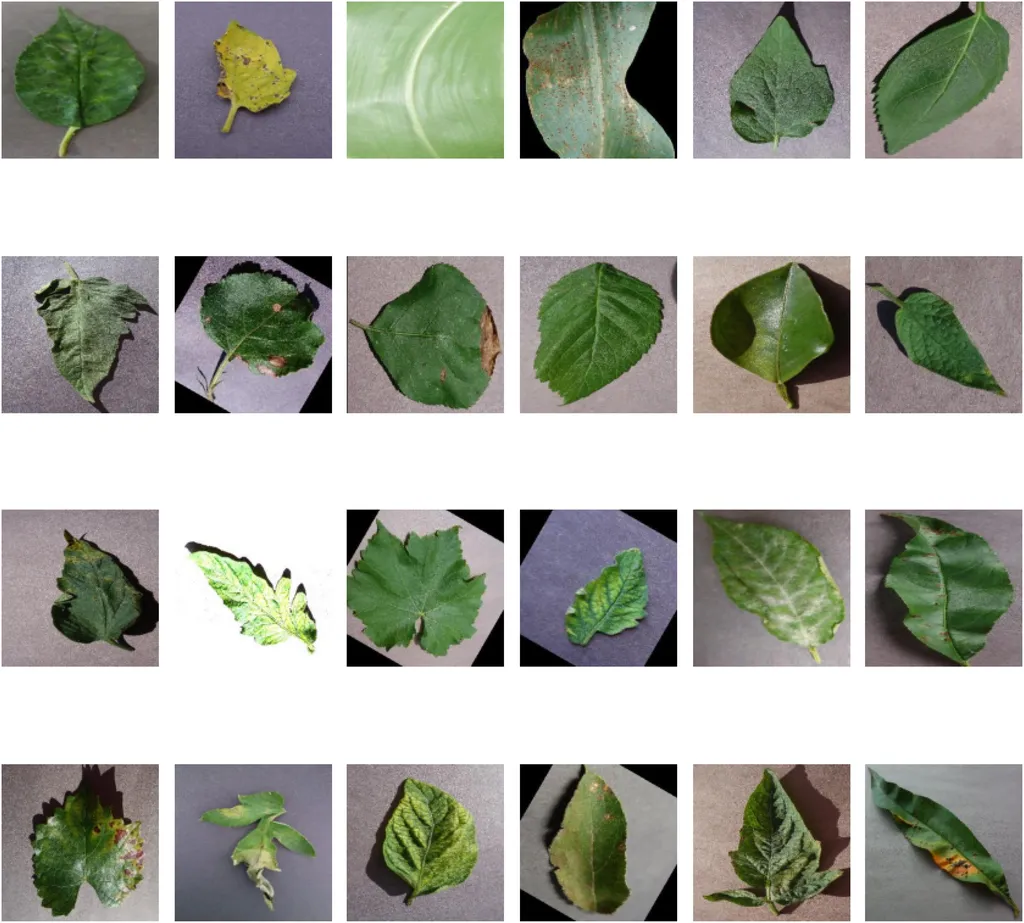
In the ever-evolving landscape of agricultural technology, a novel approach to plant disease and weed detection has emerged, promising to enhance the precision and reliability of automated systems. Researchers have introduced SEAFEC, a Spatial-Edge Adaptive Feature Enhancement Convolution, a groundbreaking convolutional module designed to tackle the persistent challenges of multi-scale variations and blurred boundaries in agricultural imagery.
The study, led by Cuimin Sun from the School of Computer, Electronics and Information at Guangxi University in China, was recently published in *Frontiers in Plant Science*. SEAFEC represents a significant leap forward in the application of deep learning to crop protection. The module employs a dual-branch design, where the SCARF branch dynamically adjusts receptive fields to capture varying scales, while the MEFE branch explicitly strengthens edge features for enhanced boundary precision.
“This dual-branch approach allows SEAFEC to adapt to the complex and varied conditions found in agricultural fields,” Sun explained. “By addressing both scale and boundary challenges simultaneously, we can provide more accurate and reliable diagnostics for plant diseases and weed management.”
The implications for the agriculture sector are substantial. Accurate and timely detection of plant diseases and weeds is crucial for maintaining crop health and yield. Traditional methods often fall short due to the variability in plant sizes, shapes, and the often-blurred boundaries between healthy and diseased tissues. SEAFEC’s ability to improve accuracy, mean Average Precision (mAP), and mean Intersection over Union (mIoU) across different tasks highlights its potential to revolutionize precision agriculture.
“In practical terms, this means farmers and agronomists can rely on more precise diagnostics, leading to better-informed decisions about pest and disease management,” Sun added. “This can result in reduced crop losses, improved yield, and more sustainable farming practices.”
The commercial impact of such technology cannot be overstated. As the global population continues to grow, the demand for efficient and sustainable agricultural practices increases. Automated systems that can accurately detect and diagnose plant diseases and weeds can significantly reduce the need for chemical interventions, leading to more environmentally friendly farming practices.
Moreover, the adaptability of SEAFEC suggests it could be integrated into existing agricultural technologies, enhancing their performance without the need for complete overhauls. This could accelerate the adoption of smart agriculture technologies, making them more accessible and beneficial to a broader range of farmers.
Looking ahead, the success of SEAFEC opens up new avenues for research and development in the field of agricultural technology. Future studies could explore the integration of SEAFEC with other advanced technologies, such as drones and satellite imagery, to provide even more comprehensive and real-time monitoring of crop health.
“This is just the beginning,” Sun noted. “The potential applications of SEAFEC are vast, and we are excited to see how it can be further developed and utilized to support the future of agriculture.”
As the agriculture sector continues to embrace technological advancements, innovations like SEAFEC are poised to play a pivotal role in shaping the future of crop protection and sustainable farming. By enhancing the accuracy and reliability of automated systems, SEAFEC not only addresses current challenges but also paves the way for more sophisticated and effective agricultural technologies.