
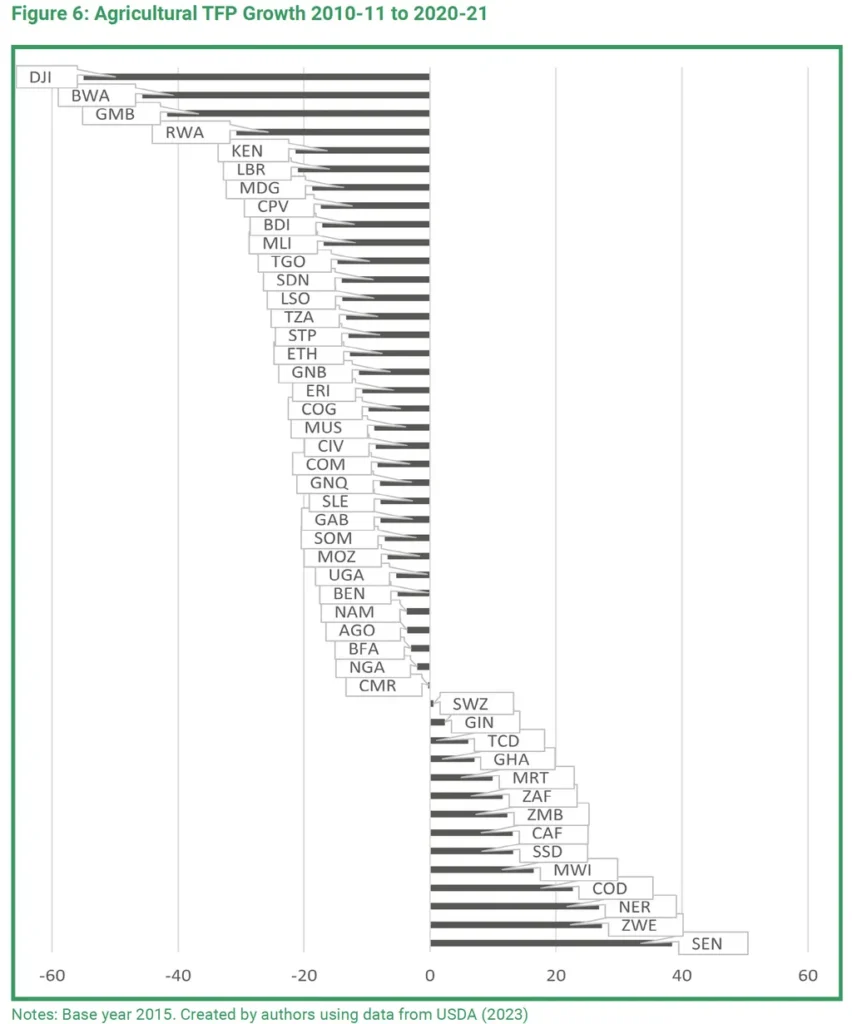
In the heart of Africa, where agriculture is the backbone of many economies, a silent threat is looming—rising temperatures. A recent study published in *Sustainable Futures* sheds light on the profound impact that temperature changes have on agricultural productivity across the continent. The research, led by Adéla Malinová from the Department of Economics at the Czech University of Life Sciences, offers a stark warning: higher temperatures are significantly dampening agricultural value added, a critical metric for economic performance in the sector.
The study, which spans 46 African countries from 1993 to 2022, employs a robust suite of econometric tools, including error correction models, impulse-response analysis, and non-parametric partial-kernel regression. The findings are clear and alarming: temperature increases have a statistically significant and negative effect on agricultural value added. “The results are not just statistically significant; they are economically meaningful,” Malinová emphasizes. “This means that as temperatures rise, the economic output from agriculture drops, which has profound implications for food security and rural livelihoods.”
The implications for the agricultural sector are far-reaching. Agriculture value added is a key indicator of the sector’s contribution to a country’s economy, encompassing everything from crop yields to resource use efficiency. As temperatures climb, farmers face reduced productivity, which can lead to lower incomes and increased food insecurity. “This isn’t just about yields; it’s about the economic viability of entire communities,” Malinová notes. “When agricultural productivity declines, it ripples through the economy, affecting everything from local markets to national GDP.”
The study’s findings underscore the urgent need for targeted adaptation strategies. As climate change continues to push temperatures higher, African nations must invest in resilient agricultural practices and technologies. This could include drought-resistant crops, improved irrigation systems, and better weather forecasting tools. “Adaptation isn’t just a choice; it’s a necessity,” Malinová states. “We need to act now to mitigate the worst impacts and ensure that agriculture remains a viable and productive sector.”
The research also highlights the importance of understanding the non-linear relationships between temperature and agricultural performance. Traditional linear models may not capture the full complexity of these dynamics, which is why the study employs advanced econometric techniques. “Non-linear regression allows us to see the nuances,” Malinová explains. “It’s not just about the average effect; it’s about how different levels of temperature impact productivity in the short and long run.”
As the world grapples with the realities of climate change, this study serves as a wake-up call for policymakers, farmers, and investors. The agricultural sector is on the front lines of climate change, and the economic stakes are high. “We need to think about agriculture not just in terms of food production but as a critical economic engine,” Malinová concludes. “Protecting it means protecting the livelihoods of millions and ensuring a sustainable future.”
Published in *Sustainable Futures* and led by Adéla Malinová from the Department of Economics at the Czech University of Life Sciences, this research offers a compelling case for urgent action. As temperatures rise, the agricultural sector must adapt or face significant economic losses. The question is no longer if adaptation is necessary but how quickly and effectively it can be implemented. The future of African agriculture hangs in the balance, and the time to act is now.