
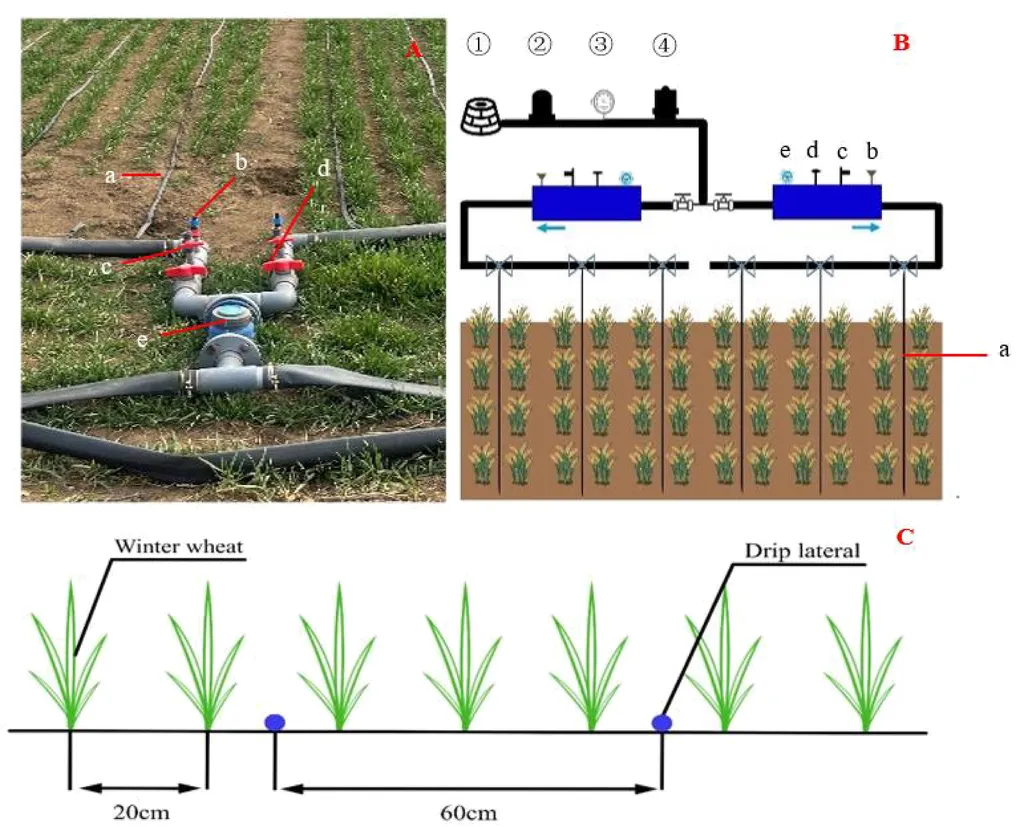
In the quest to balance food security and environmental sustainability, a recent study published in *Agricultural Water Management* offers promising insights for the agriculture sector. The research, led by Donghua Liu from the College of Life Science at Henan Normal University, explores how optimizing water and fertilizer management can significantly reduce greenhouse gas (GHG) emissions while enhancing the economic viability of wheat production.
The study, conducted over two years, compared the effects of drip irrigation and traditional flood irrigation combined with varying nitrogen application rates on wheat yield, GHG emissions, and net eco-economic benefits. The findings reveal that drip irrigation not only reduced the emission fluxes of nitrous oxide (N2O) and carbon dioxide (CO2) but also enhanced the uptake of methane (CH4), all with only a marginal impact on wheat yield.
“Drip irrigation combined with moderate nitrogen application achieved the best balance among yield, emission reduction, and economic benefits,” said Liu. This integrated approach highlights the potential for regulating soil conditions and microbial activity to mitigate GHG emissions from farmland.
From a commercial perspective, the study indicates that drip irrigation combined with a nitrogen application rate of 240 kg per hectare (N2) reduced production inputs and carbon emission costs, ultimately improving net eco-economic benefits. This finding is particularly significant for farmers and agribusinesses looking to adopt low-carbon practices without compromising productivity.
The research underscores the importance of integrated water and nitrogen management in achieving sustainable agricultural intensification. As the global agriculture sector faces increasing pressure to reduce its carbon footprint, these findings provide practical insights and a valuable reference for policymakers and stakeholders.
Looking ahead, the study suggests that future research should focus on long-term, multi-site studies and consider soil carbon dynamics to refine farmland carbon footprint assessments. This holistic approach could further support the goal of carbon neutrality in agriculture.
In an era where sustainability and profitability must go hand in hand, this research offers a roadmap for the agriculture sector to navigate the dual challenges of food security and environmental stewardship. By adopting integrated water and fertilizer management practices, farmers can not only enhance their economic returns but also contribute to a healthier planet.