
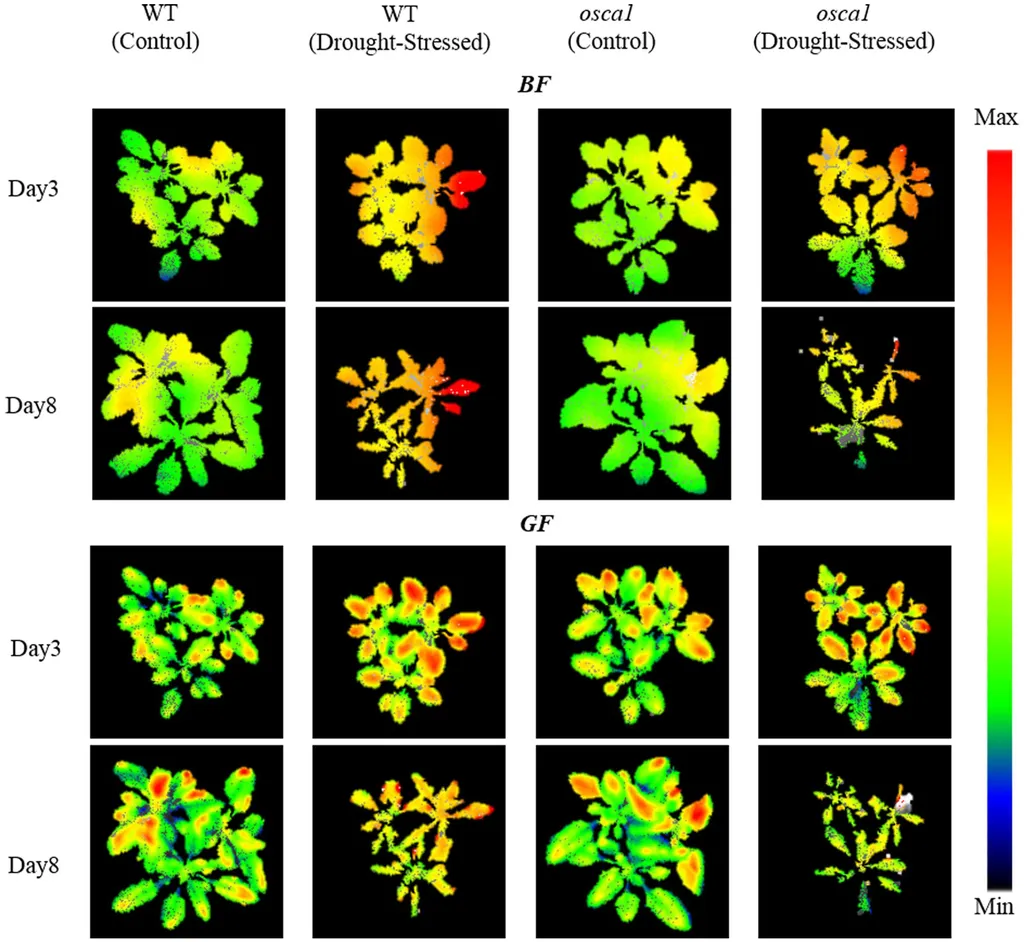
In the face of climate change, farmers are grappling with increasingly frequent and severe droughts, making early detection of water stress in crops more critical than ever. A groundbreaking study published in *Smart Agricultural Technology* introduces a novel approach to this challenge, utilizing fluorescence noise analysis to assess dehydration in plants. This method, developed by a team led by Naama Goren of the Department of Applied Physics at the Hebrew University of Jerusalem, could revolutionize precision agriculture by offering a rapid, cost-effective, and scalable solution for monitoring crop health.
The research focuses on the statistical properties of chlorophyll fluorescence fluctuations, or “noise,” which change predictably with dehydration. By analyzing these fluctuations, the team identified patterns that correlate with water deficiency, outperforming conventional fluorescence intensity methods in both precision and reliability. “We’ve discovered that the noise in chlorophyll fluorescence isn’t just random—it’s a rich source of information about the plant’s physiological state,” Goren explains. This insight opens up new avenues for automated, large-scale agricultural monitoring, potentially integrating with sensor networks or drone-based platforms.
The implications for the agriculture sector are substantial. Current methods for detecting drought stress often rely on visual inspections or labor-intensive measurements, which can be time-consuming and inefficient. This new approach promises to streamline the process, enabling farmers to make data-driven decisions about irrigation in real-time. “This technology could be a game-changer for precision agriculture,” says Goren. “It allows for early detection of water stress, which can lead to more efficient water use and improved crop yields.”
Beyond its practical applications, the research also offers a deeper understanding of the bio-physical processes underlying plant stress responses. Transmission electron microscopy confirmed structural changes in thylakoid membranes associated with the observed noise patterns, shedding light on the energetic landscape of plant cells under stress. This knowledge could inform future developments in crop breeding and stress-resistance strategies.
As climate change continues to pose challenges for global agriculture, innovative solutions like fluorescence noise analysis will be crucial in adapting to new realities. By providing a scalable, non-invasive method for monitoring crop health, this research paves the way for more resilient and sustainable farming practices. The study’s findings not only advance our understanding of plant physiology but also highlight the potential of advanced signal-processing techniques in agriculture. With further refinement and integration into existing technologies, this method could become a cornerstone of modern precision agriculture, helping farmers navigate the uncertainties of a changing climate.