
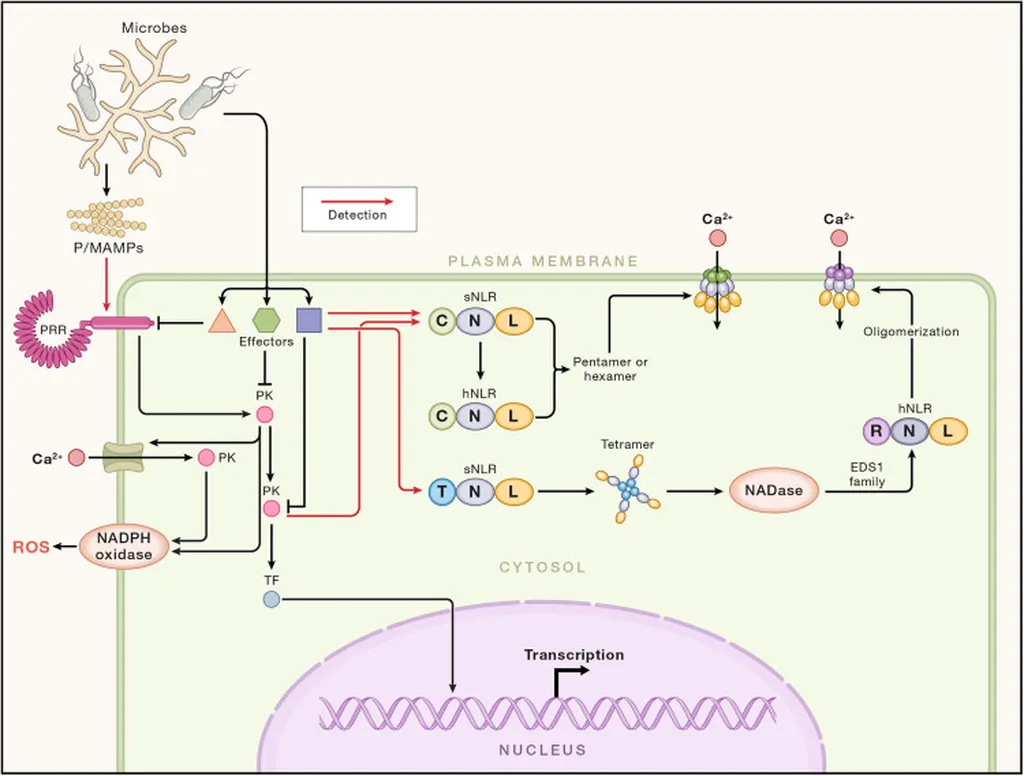
In a groundbreaking study published in *Molecular Plant-Microbe Interactions*, researchers have uncovered a crucial component in the plant immune system that could revolutionize crop protection strategies. The study, led by Seowon Choi from the Division of Applied Biosciences at Kyoto University, identifies a gene called STT3A as a key player in recognizing pathogen-derived sphingolipids, a type of fat molecule found in the cell membranes of plants and pathogens.
Plants have evolved sophisticated mechanisms to detect and respond to pathogens. One such mechanism involves recognizing pathogen-associated molecular patterns (PAMPs) through pattern recognition receptors (PRRs). This recognition triggers pattern-triggered immunity (PTI), a frontline defense mechanism that helps plants fend off infections. However, the exact components involved in this process have remained elusive until now.
The research team employed a novel screening method called Lumi-Map technology to identify Arabidopsis mutants with altered defense responses to Pi-Cer D, a sphingolipid from the oomycete pathogen *Phytophthora infestans*. They discovered that mutants with diminished responses to Pi-Cer D and another PAMP, elf18, carried mutations in the STT3A gene. STT3A encodes an oligosaccharyltransferase, an enzyme involved in the posttranslational modification of proteins.
“STT3A is essential for the proper functioning of the plant immune system,” explains Choi. “Our findings suggest that STT3A contributes to plant immunity by modifying proteins involved in the recognition of pathogen-derived sphingolipids.”
The study revealed that in stt3a mutants, the molecular mass of two key proteins, NEUTRAL CERAMIDASE 2 (NCER2) and RESISTANT TO DFPM-INHIBITION OF ABSCISIC ACID SIGNALING 2 (RDA2), appeared smaller. This indicates that STT3A is involved in the posttranslational modification of these proteins, a process known as N-glycosylation. An enzymatic deglycosylation assay confirmed that NCER2 and RDA2 are indeed N-glycosylated, highlighting the critical role of STT3A in this modification.
The commercial implications of this research are profound. Understanding the molecular mechanisms underlying plant immunity can lead to the development of more effective and sustainable crop protection strategies. By identifying the key components involved in pathogen recognition, researchers can potentially engineer crops with enhanced resistance to a wide range of pathogens, reducing the need for chemical pesticides and improving agricultural productivity.
“This discovery opens up new avenues for developing crops with improved disease resistance,” says Choi. “By harnessing the power of plant immunity, we can create more resilient and sustainable agricultural systems.”
The findings also pave the way for further research into the role of sphingolipids in plant-pathogen interactions. As lead author Seowon Choi from the Division of Applied Biosciences at Kyoto University notes, “Our study provides a foundation for future investigations into the complex interplay between plants and pathogens, ultimately leading to more innovative and effective agricultural technologies.”
In summary, this study not only advances our understanding of plant immunity but also holds significant promise for the agriculture sector. By unlocking the secrets of plant defense mechanisms, researchers are one step closer to developing crops that can withstand the challenges posed by ever-evolving pathogens, ensuring food security for a growing global population.