
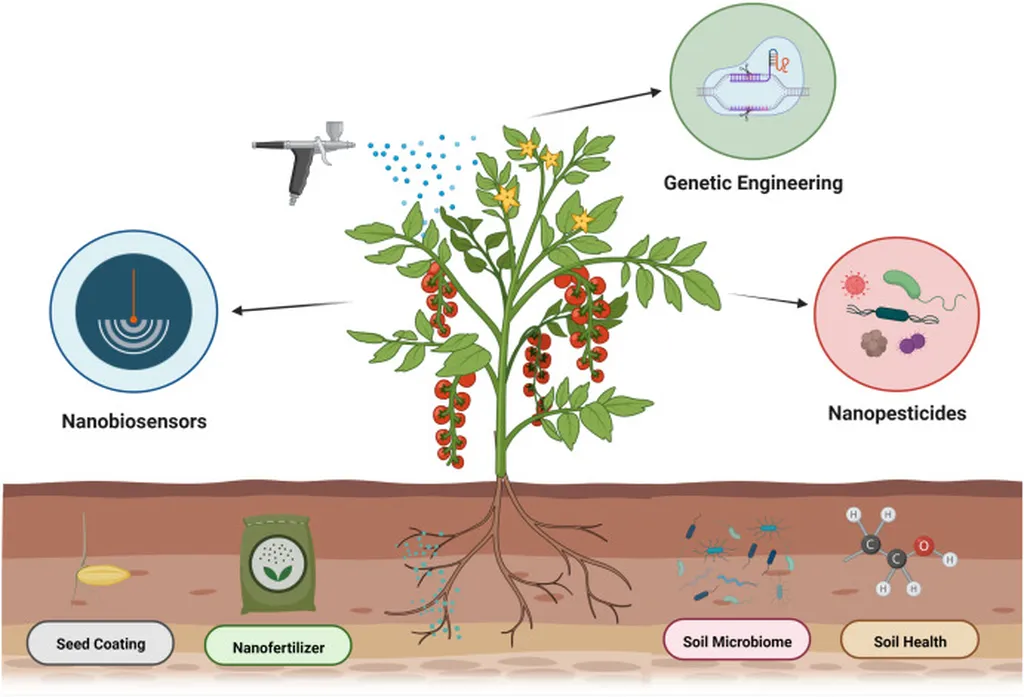
In a groundbreaking study published in *Industrial Crops and Products*, researchers have developed a novel nanoformulation that significantly enhances photosynthetic CO2 sequestration in plants. The research, led by Leonard M. Kiirika of the Institute of Plant Genetics of the Polish Academy of Sciences, explores the potential of ionic liquid-functionalized nanoceria (CeO2) to boost plant growth and CO2 fixation, offering promising avenues for sustainable agriculture and climate change mitigation.
The study focuses on the development of a nanoformulation where the surface of nanoceria is functionalized with an ionic liquid, cholinium ascorbate ([Cho][Asc]). This innovative approach aims to overcome the limitations of CO2 diffusion and abiotic stress in plants, thereby enhancing photosynthetic processes. The results are striking: compared to control groups, plants treated with the CeO2 + 50 mM [Cho][Asc] nanoformulation exhibited a two-fold increase in photosynthetic rate and a 198% boost in dry biomass accumulation.
“Our findings demonstrate that the CeO2 + [Cho][Asc] nanoformulation not only improves plant growth but also significantly enhances CO2 sequestration,” Kiirika explained. “This dual benefit makes it a promising tool for sustainable agriculture and carbon capture.”
The study revealed that the application of CeO2 + 50 mM [Cho][Asc] resulted in CO2 sequestration of 3.02 tons per hectare, which is 80–110% higher than when CeO2 and the ionic liquid were applied separately, and 279% higher than the control. Importantly, this enhancement in photosynthetic CO2 fixation did not compromise tobacco seed yield, with treated plants showing significantly higher seed yields than control plants.
The implications for the agriculture sector are substantial. Enhanced photosynthetic CO2 fixation can lead to increased crop yields and improved resilience to environmental stresses, addressing both food security and climate change challenges. “This research opens up new possibilities for developing nanoformulations that can be tailored to specific crops and environmental conditions,” Kiirika added. “It’s a step towards more efficient and sustainable agricultural practices.”
As the world seeks innovative solutions to mitigate climate change and enhance food security, this study provides a compelling case for the use of engineered nanomaterials in agriculture. The findings contribute to the growing body of research on sustainable agriculture and highlight the potential of nanotechnology to revolutionize the field.
The research, published in *Industrial Crops and Products*, was led by Leonard M. Kiirika at the Institute of Plant Genetics of the Polish Academy of Sciences, offering a glimpse into the future of agricultural innovation.