
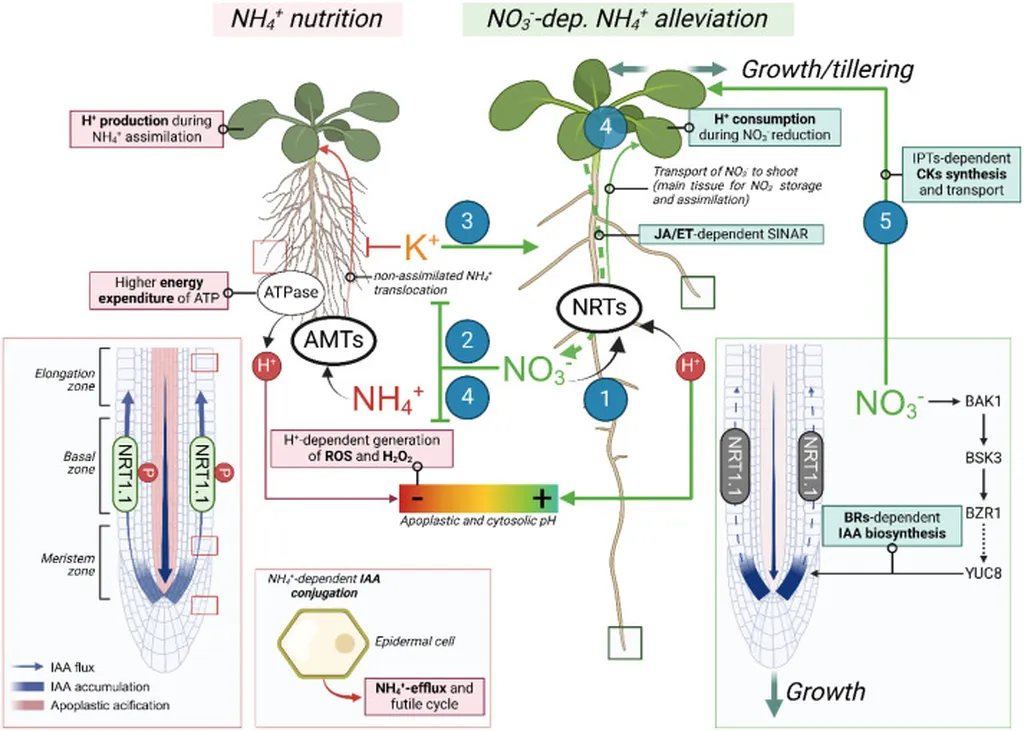
In the quest for sustainable and cost-effective agricultural practices, scientists are unraveling the intricate dance between nitrate and ammonium in plant nutrition. A recent review published in the *Horticultural Plant Journal* sheds light on how nitrate can mitigate ammonium toxicity in plants, offering promising insights for the agriculture sector.
Ammonium, a common form of nitrogen in fertilizers, is often less expensive and more environmentally friendly than nitrate. However, its toxicity limits its widespread use in agriculture. “Ammonium toxicity in plants remains poorly understood despite extensive research,” notes Mikel Rivero-Marcos, lead author of the study and a researcher at the Leibniz Institute of Plant Genetics and Crop Plant Research (IPK) in Germany and the Public University of Navarre (UPNA) in Spain. This review aims to change that by exploring the synergistic effects of nitrate in counteracting ammonium toxicity.
The study reveals that nitrate plays a multifaceted role in alleviating ammonium toxicity. It helps neutralize the acidification caused by ammonium uptake, enhances the absorption of potassium—a crucial counterion for nitrate—and triggers signaling pathways that boost ammonium assimilation, reactive oxygen species (ROS) scavenging, and the biosynthesis of growth hormones. “The ability to counteract the ammonium-induced acidification through nitrate uptake and metabolism, the enhancement of potassium uptake as an essential nitrate counterion, and the nitrate-dependent signaling of key factors involved in ammonium assimilation, ROS scavenging, and growth hormone biosynthesis, are the most relevant hallmarks,” Rivero-Marcos explains.
The implications for agriculture are significant. By understanding how plants use nitrate to mitigate ammonium toxicity, researchers can develop strategies to optimize nitrogen fertilization. This could lead to more efficient use of fertilizers, reduced environmental impact, and increased crop yields. “As ammonium toxicity limits N fertilization options and reduces agricultural yields, when it could be a more sustainable and cheaper alternative to nitrate, this review provides a better understanding of how plants use nitrate to counteract the problematic aspects of ammonium nutrition,” Rivero-Marcos adds.
The research also suggests that the availability of nitrate and ammonium has driven ecological selection in plants, shaping current nitrogen preferences and potentially leading to the development of nitrate-dependent and ammonium-sensitive domesticated crops. This historical perspective offers a new lens through which to view plant nutrition and could inform future breeding programs aimed at improving nitrogen use efficiency.
Looking ahead, this review could pave the way for innovative agricultural practices that leverage the synergistic effects of nitrate and ammonium. By fine-tuning fertilization strategies, farmers could enhance crop productivity while minimizing environmental harm. As the global population grows and the demand for sustainable food production intensifies, such advancements are more critical than ever.
In the words of Rivero-Marcos, “This review provides a better understanding of how plants use nitrate to counteract the problematic aspects of ammonium nutrition.” With this knowledge, the agriculture sector can move closer to a future where ammonium fertilization is not just a cheaper alternative but a viable and sustainable option for farmers worldwide.