
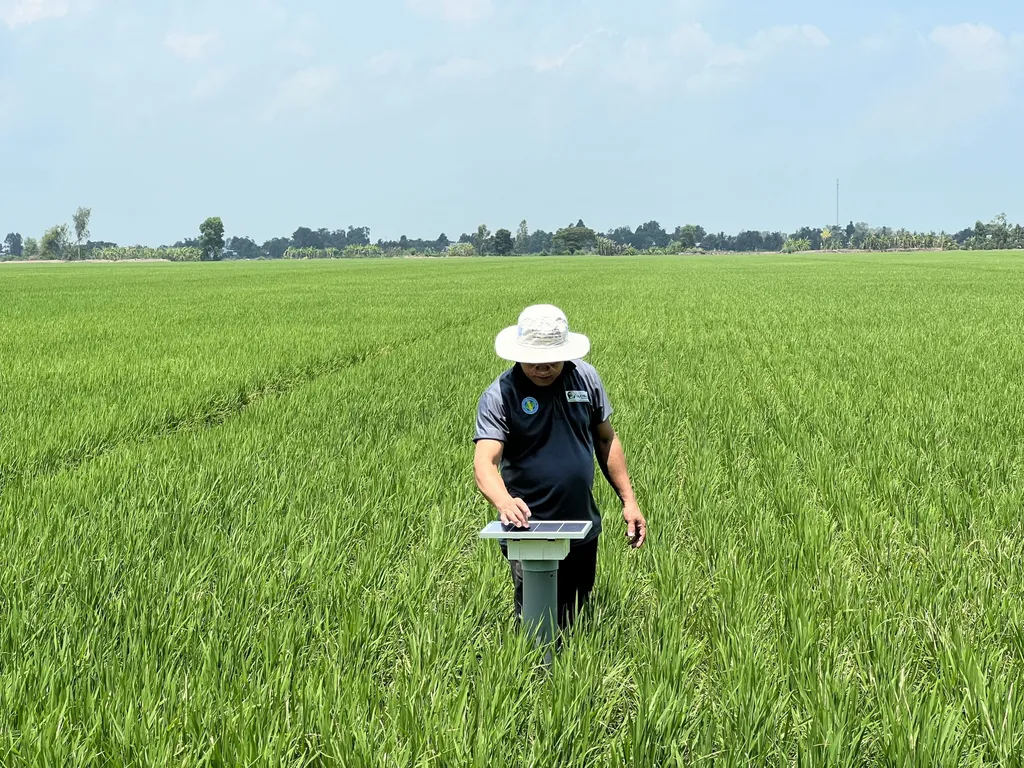
In a significant stride towards modernizing rice cultivation in Vietnam, the International Rice Research Institute (IRRI), in collaboration with the Dong Nai Department of Agriculture and Environment and the CGIAR Sustainable Farming Program, unveiled a groundbreaking technology at a field demonstration in Dong Nai Province on December 4, 2025. The event showcased the mechanized dry direct seeding technology (mDSR) combined with fertilizer deep placement, marking its official introduction in Vietnam.
This innovative technology, developed in collaboration with Tu Sang Company, integrates mechanized dry direct seeding and deep fertilizer placement into a single machine. It addresses long-standing challenges in traditional dry seeding, such as high labor costs, uneven germination, and significant seed loss. Dr. Hung, Senior Scientist at IRRI, highlighted the advantages of the dry direct seeding approach, noting significant improvements in input efficiency, environmental sustainability, and overall productivity.
By adopting this method, farmers can substantially reduce operational costs. The new technology lowers seed rates to under 60 kg/ha and cuts nitrogen fertilizer use by approximately 20% through just two seasonal applications. Environmentally, the impact is equally transformative, with scientific evidence showing up to a 50% reduction in water consumption and a 30% decrease in greenhouse gas emissions compared to traditional wet seeding. Early results also indicate yield increases exceeding 5%, complemented by a 20–30% reduction in pesticide requirements and enhanced resistance to lodging.
Central to the demonstration was the innovative machine, available in 12-row and 16-row configurations, designed for both wet and dry conditions. In its dry direct seeding mode, the machine is compact and robust, weighing approximately 619 kg and compatible with tractors of at least 25 horsepower. It offers a field capacity of 0.5-1.0 hectares per hour, making it an ideal solution for small- to medium-scale farmers and mechanized service providers.
Mr. Le Thanh Tung, Vice Chairman of the Vietnam Rice Sector Association (VIETRISA), emphasized the importance of this demonstration as a critical starting point for evaluating new mechanization technologies in Vietnam. The technology is particularly well-suited for water-constrained regions like the South-Central Coast, the Central Highlands, and Southeast Vietnam. Local farmers at the event explored the machine’s versatility, with IRRI experts noting that while currently optimized for rice, minor modifications could allow the system to be used for other crops like maize and peanuts.
This technological advancement represents a significant step forward in sustainable agriculture, offering farmers a more efficient and environmentally friendly approach to rice cultivation. As Vietnam continues to explore and adopt new mechanization technologies, the potential benefits for both farmers and the environment are substantial, paving the way for a more sustainable and productive future in agriculture.