
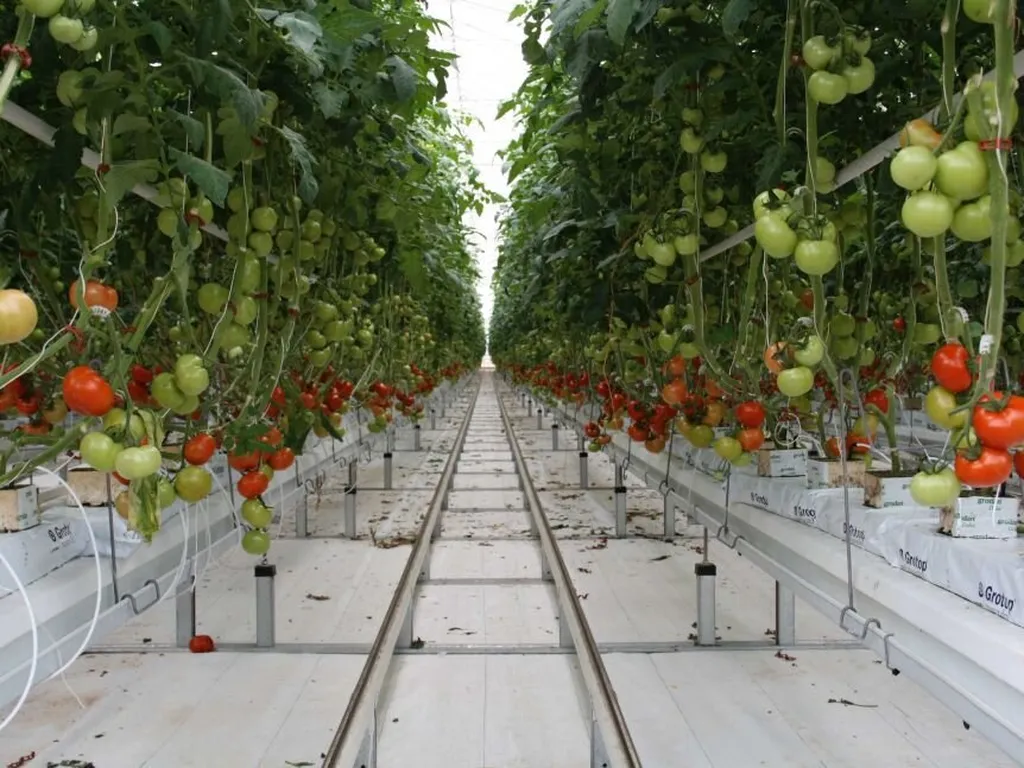
In the heart of modern agriculture, where technology and tradition intersect, a new breakthrough is poised to revolutionize greenhouse tomato production. Researchers have developed a lightweight, high-precision model named DSS-YOLO, designed to accurately detect tomato flowers and stamens, a critical step towards automated pollination and intelligent crop management.
The challenges faced in detecting these delicate plant parts are not trivial. Overlapping flowers, leaf occlusion, complex backgrounds, and the intricacies of small-scale feature extraction have long hindered the development of effective detection models. “These factors significantly impact detection accuracy, which is crucial for automated pollination,” explains Shan Zhang, lead author of the study published in ‘Agronomy’ and a researcher at the School of Mechanical and Electrical Engineering, Hebei Agricultural University.
To overcome these hurdles, Zhang and his team replaced the backbone network of YOLOv11n with HGNetv2 and incorporated depthwise separable convolution (DWConv) to create a multiscale lightweight feature extraction network called DWHGNetv2. This innovation enhances feature extraction capability for tomato flowers while reducing computational cost and overall model complexity. “By optimizing the model architecture, we’ve improved both efficiency and accuracy,” Zhang notes.
The team further improved computational efficiency and feature representation by replacing traditional convolution-based downsampling layers with the SCDown module. Additionally, they introduced the SIoU loss function to optimize the localization accuracy of angle-sensitive targets, such as stamens.
The results are impressive. DSS-YOLO consistently outperforms the baseline YOLOv11n, reducing model size, parameter count, and computational cost by 34%, 36%, and 35%, respectively. Meanwhile, precision, recall, and mean Average Precision at an IoU threshold of 0.5 ([email protected]) are improved by 1.1%, 1.0%, and 0.7%, respectively.
The commercial implications for the agriculture sector are substantial. Accurate and efficient detection of tomato flowers and stamens can significantly enhance the capabilities of pollination robots, leading to increased productivity and reduced labor costs. This technology could also be adapted for use with other crops, further broadening its impact.
As the agriculture industry continues to embrace technological advancements, innovations like DSS-YOLO pave the way for smarter, more efficient farming practices. The research conducted by Zhang and his team not only addresses current challenges but also sets the stage for future developments in automated pollination and intelligent crop management. In a rapidly evolving field, this work stands as a testament to the power of innovation in driving agricultural progress.