
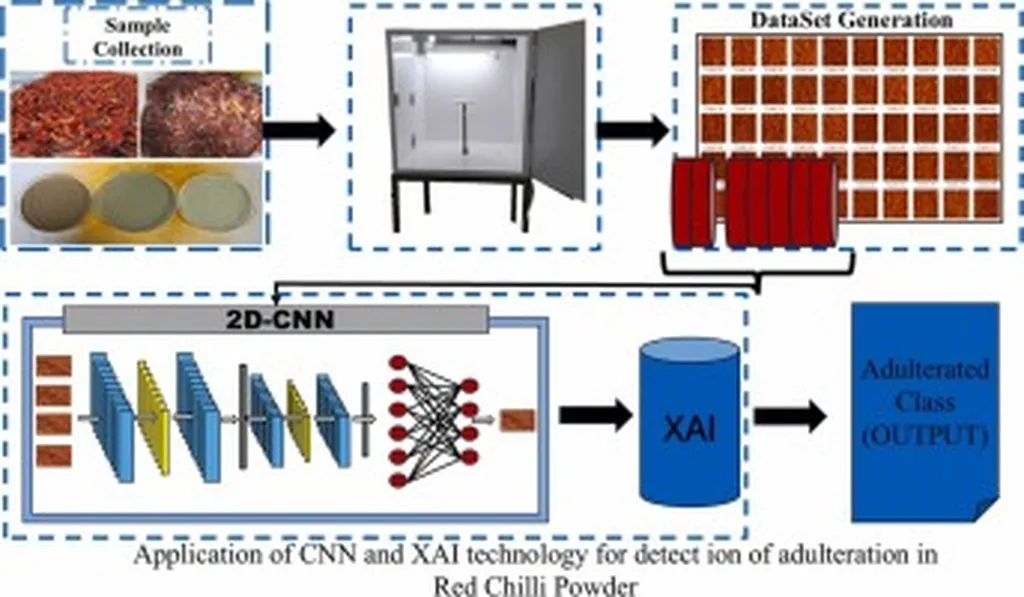
In the ever-evolving landscape of agricultural technology, a groundbreaking study published in the journal *Foods* is set to revolutionize the way we detect adulteration in *Zanthoxylum bungeanum* powder, a popular spice known for its unique flavor and medicinal properties. The research, led by Yue Wang from the Key Laboratory of Huang-Huai-Hai Smart Agricultural Technology, introduces IncepSpect-CBAM, a cutting-edge model that promises to streamline quality assessment in the food industry.
Adulteration of powdered spices is a significant challenge, often requiring labor-intensive and time-consuming methods for detection. Traditional near-infrared spectroscopy (NIRS) models, while useful, are typically tailored to specific adulterants and demand extensive preprocessing. This limits their practical application in real-world scenarios. Enter IncepSpect-CBAM, an end-to-end one-dimensional convolutional neural network that integrates multi-scale Inception modules, a Convolutional Block Attention Module (CBAM), and residual connections. This innovative model directly learns features from raw spectra, maintaining robustness across multiple adulteration scenarios.
The implications for the agriculture sector are profound. “This model enables high-precision quantitative analysis of *Zanthoxylum bungeanum* powder content across diverse adulteration types,” explains Yue Wang, the lead author of the study. “It provides a robust technical framework for rapid, non-destructive quality assessment of powdered food products using near-infrared spectroscopy.”
The model’s performance is nothing short of impressive. When evaluated on a dataset containing four common adulterants—corn flour, wheat bran powder, rice bran powder, and *Zanthoxylum bungeanum* stem powder—IncepSpect-CBAM achieved a Root Mean Square Error of Prediction (RMSEP) of 0.058 and a coefficient of determination for prediction (R2P) of 0.980. These results outperform traditional methods like Partial Least Squares Regression (PLSR) and Support Vector Regression (SVR), as well as deep learning benchmarks such as 1D-CNN and DeepSpectra.
The commercial impacts of this research are far-reaching. For farmers and producers, the ability to quickly and accurately assess the quality of their products can lead to increased efficiency and reduced waste. For consumers, it ensures a higher standard of food safety and quality. “This technology has the potential to transform the way we approach quality control in the food industry,” says Wang. “It’s a game-changer for ensuring the authenticity and purity of our food products.”
As we look to the future, the success of IncepSpect-CBAM opens up new avenues for research and development in the field of agricultural technology. The model’s ability to handle diverse adulteration scenarios suggests that similar approaches could be applied to other types of food products, further enhancing our capacity for non-destructive quality assessment. This research, published in *Foods* and led by Yue Wang from the Key Laboratory of Huang-Huai-Hai Smart Agricultural Technology, is a testament to the power of innovation in addressing real-world challenges in the agriculture sector.