
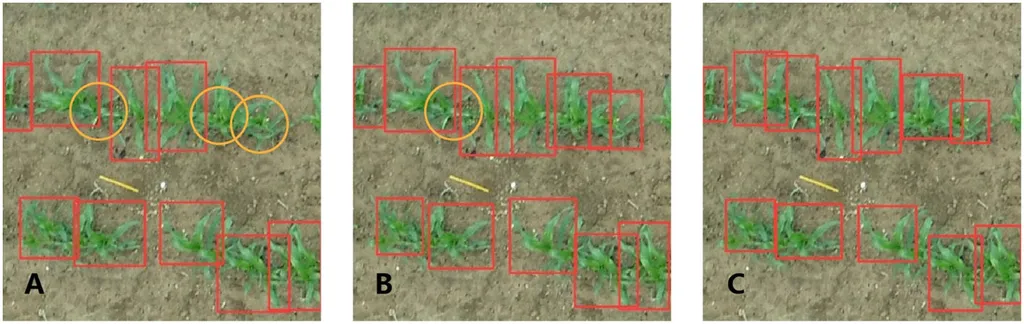
In the quest for precision agriculture, researchers have made a significant stride in automating corn plant detection, offering farmers a powerful tool to enhance crop monitoring and management. A recent study published in *Remote Sensing* demonstrates the effectiveness of the YOLOv9-small model in detecting and counting corn plants under varying field conditions, potentially revolutionizing how farmers approach crop management.
The research, led by Thiago O. C. Barboza from the Agriculture Department at the Lavras School of Agricultural Sciences, Federal University of Lavras (UFLA), Brazil, evaluated the model’s performance across different soil backgrounds, growth stages, and unmanned aerial vehicle (UAV) flight heights. The findings reveal that the YOLOv9-small model achieved high accuracy in detecting corn plants, particularly at the V3 and V5 growth stages, with mean average precision (mAP50) values exceeding 85% in conventional tillage fields.
“This model shows great promise for early-stage corn detection, which is crucial for making timely management decisions,” Barboza said. The study found that the model’s performance was slightly lower in gray/red-brown soil conditions due to background interference, but it still maintained high precision, especially at the V5 stage.
The research also explored the impact of flight height on detection accuracy. While increasing the flight height from 30 meters to 70 meters reduced accuracy by 8–12%, the model still performed well, particularly at the V5 stage. “At 70 meters, the model’s performance is acceptable, which could help optimize mapping time and reduce operational costs,” Barboza noted.
The implications for the agriculture sector are substantial. Accurate stand count and growth stage detection are essential for effective crop monitoring, enabling farmers to make informed decisions about irrigation, fertilization, and pest control. Traditional methods often overlook field variability, leading to poor management decisions and potential yield losses. By automating the detection process, farmers can achieve more precise and efficient crop management, ultimately improving yields and profitability.
The study’s findings suggest that the YOLOv9-small model could be a game-changer for precision agriculture. As the technology continues to evolve, it is likely that similar models will be developed for other crops, further enhancing the capabilities of smart farming systems. The research also highlights the importance of considering soil background and growth stages when implementing such technologies, ensuring that they are tailored to the specific needs of each farm.
In the broader context, this research underscores the potential of computer vision and deep learning in transforming agriculture. As these technologies become more accessible and affordable, they could democratize precision agriculture, enabling small-scale farmers to benefit from advanced monitoring and management tools. This could lead to a more sustainable and productive agricultural sector, capable of meeting the growing food demands of a rapidly expanding global population.
The study, “Corn Plant Detection Using YOLOv9 Across Different Soil Background Colors, Growth Stages, and UAV Flight Heights,” was published in *Remote Sensing* and represents a significant step forward in the field of smart farming. As the agriculture sector continues to embrace digital technologies, research like this will play a crucial role in shaping the future of farming, ensuring that it is more efficient, sustainable, and resilient.