
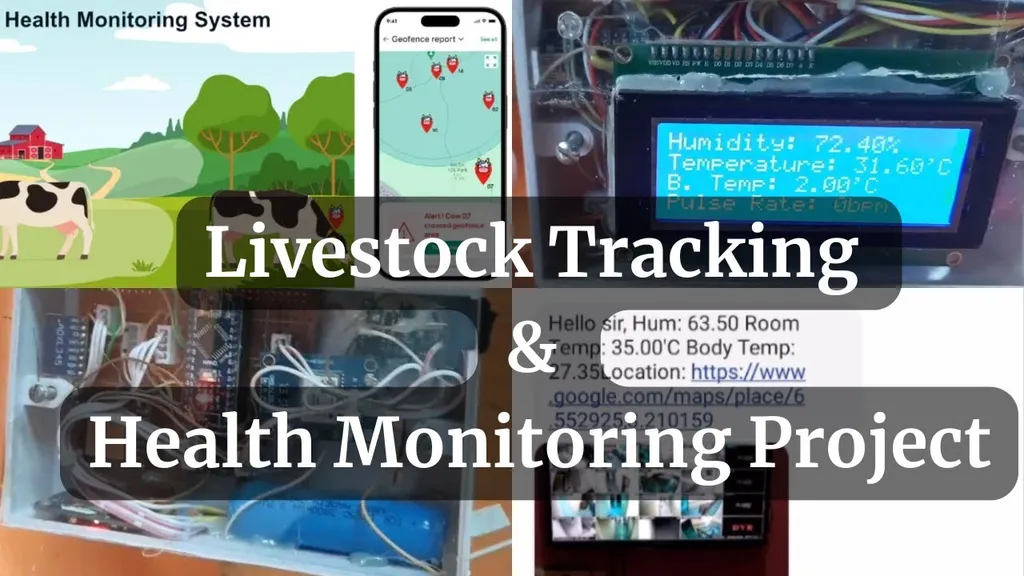
In the ever-evolving landscape of agricultural technology, a recent innovation stands out, promising to revolutionize animal health research and, by extension, the broader agriculture sector. Researchers have developed a custom-built, all-in-one environmental measurement and control system (EMCS) using Arduino, a popular open-source electronics platform. This system, detailed in a study published in the journal ‘Sensors’, is poised to transform how farmers and researchers monitor and control indoor environments for livestock.
The EMCS integrates an array of sensors to detect and record a multitude of environmental parameters, including luminosity, carbon dioxide and ammonia gas concentrations, dust particle counts, air speed, temperature, and humidity. This comprehensive approach allows for real-time monitoring and control of the environment, ensuring optimal conditions for animal health and well-being.
Dan Hofstetter, lead author of the study and a researcher at the Department of Agricultural and Biological Engineering, University of Florida, explains the significance of this development: “The specific needs of agricultural systems vary widely, often requiring custom instrumentation and datalogging solutions. Our system addresses this gap by providing a flexible, reprogrammable solution that can be tailored to different research and farming environments.”
The implications for the agriculture sector are substantial. By enabling precise control over environmental factors, the EMCS can help farmers optimize growing conditions, leading to healthier livestock and improved productivity. For instance, the system’s ability to monitor and control ammonia and dust levels can significantly enhance the health of broiler chickens, as demonstrated in a six-week case study conducted by the researchers.
Moreover, the use of readily available and affordable components like Arduino and 3D printing makes this technology accessible to a wide range of users, from large-scale commercial farms to small-scale operations. This democratization of technology could drive innovation and improve practices across the agricultural industry.
Looking ahead, the EMCS developed by Hofstetter and his team could pave the way for more sophisticated and integrated environmental control systems. As Hofstetter notes, “The flexibility of our system allows for easy reprogramming and adaptation to different purposes, making it a versatile tool for various agricultural applications.”
In conclusion, this research represents a significant step forward in the field of agricultural technology. By providing a customizable, cost-effective solution for environmental measurement and control, it has the potential to shape the future of animal health research and farming practices, ultimately contributing to a more sustainable and productive agriculture sector.