
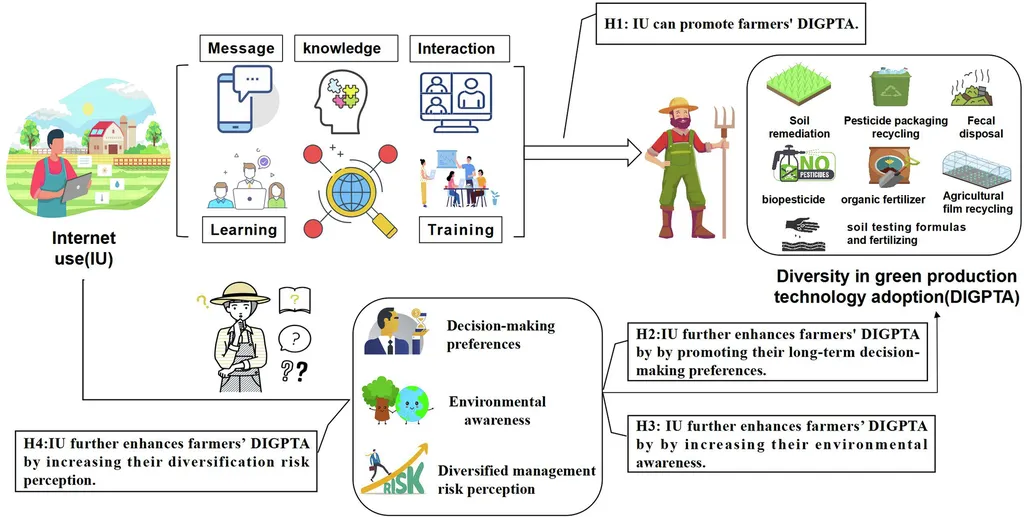
In the heart of China’s Jiangxi Province, a quiet revolution is taking root, one that could reshape the future of agriculture and bolster the sector’s commercial prospects. A recent study published in *Frontiers in Sustainable Food Systems* has shed light on the pivotal role that internet use plays in accelerating the adoption of smart farming (SF) practices among vegetable farmers. The research, led by Zanzan Wu from the School of Economics and Management at Jiangxi Agricultural University, offers a compelling roadmap for policymakers, agritech innovators, and farmers alike.
The study, which surveyed 603 rural households, employed sophisticated statistical models to unravel the complex dynamics at play. The findings are clear: internet use significantly boosts farmers’ adoption of smart farming technologies. “Internet use is not just a tool; it’s a catalyst that can transform traditional farming practices,” Wu asserts. This conclusion held firm even after rigorous robustness tests, underscoring the reliability of the findings.
But the story doesn’t end there. The research delves deeper, revealing that internet use influences farmers’ adoption of smart farming through two key mediators: risk attitude and economic cost. “By improving access to information and reducing transaction costs, the internet helps farmers mitigate risks and lower economic barriers,” explains Wu. These mediators account for 8.56% and 6.81% of the impact, respectively, highlighting the multifaceted role of digital connectivity in agricultural modernization.
Government incentives also emerge as a powerful moderator in this process. Policies that encourage internet use and smart farming adoption can amplify the positive effects, creating a virtuous cycle of innovation and productivity. “Government support is crucial in bridging the digital divide and fostering a conducive environment for technological adoption,” Wu notes.
The study also underscores the importance of targeting specific demographic groups. Younger farmers and those with higher education levels are more likely to benefit from internet-driven smart farming initiatives. However, the research also calls for tailored solutions for older and less educated farmers, emphasizing the need for simplified internet tools and targeted training programs.
The commercial implications of this research are profound. As the agriculture sector grapples with the challenges of climate change, resource scarcity, and market volatility, smart farming offers a beacon of hope. By leveraging the internet, farmers can enhance productivity, reduce costs, and tap into new markets. This not only boosts individual farm incomes but also strengthens the overall resilience and competitiveness of the agriculture sector.
Looking ahead, the research points to several promising avenues for future development. Policymakers should prioritize internet infrastructure development in major vegetable-producing areas, ensuring that all farmers, regardless of their age or education level, can reap the benefits of digital connectivity. Agritech innovators, meanwhile, should focus on developing user-friendly tools and platforms that cater to the diverse needs of farmers. Additionally, government subsidy policies linked to internet usage and smart farming adoption could provide the necessary incentives for widespread adoption.
In the words of Wu, “The future of agriculture lies in smart farming, and the internet is the key that unlocks its potential.” As the sector stands on the cusp of a digital revolution, this research offers a timely and invaluable guide for navigating the path ahead. By harnessing the power of the internet, the agriculture sector can drive sustainable growth, enhance food security, and create new opportunities for farmers and businesses alike.