
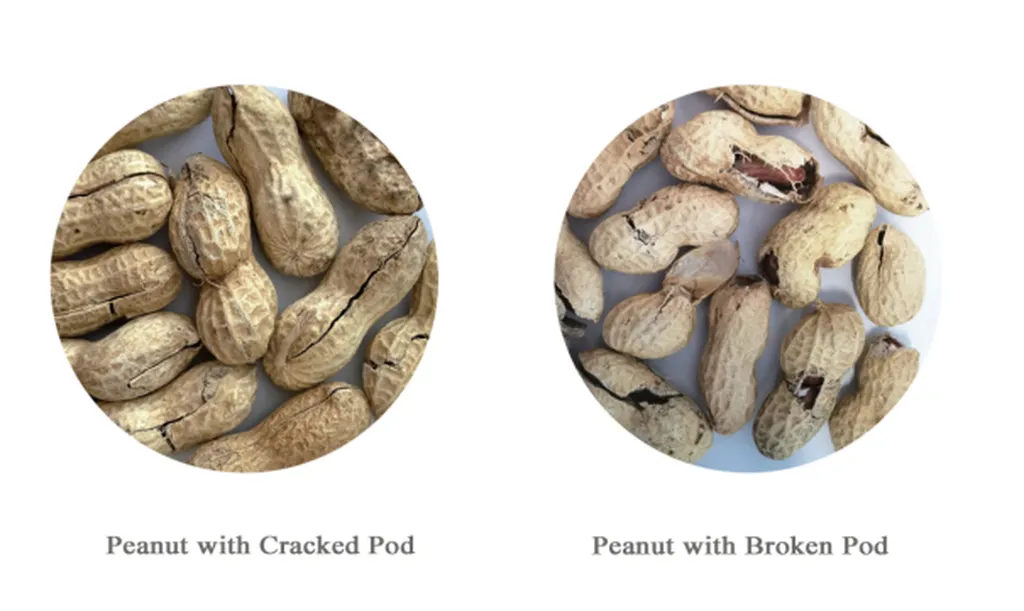
In the heart of China’s Fujian province, a groundbreaking development is set to revolutionize the way we assess one of the world’s most important economic crops: peanuts. Researchers at the Institute of Digital Agriculture, led by Yongkuai Chen, have developed a high-precision peanut pod detection device that promises to transform the agriculture sector. This innovation, detailed in a recent study published in *Applied Sciences*, leverages advanced deep learning techniques to significantly improve the efficiency and accuracy of peanut pod detection, offering substantial commercial benefits for farmers and breeders alike.
The device employs an improved BTM-YOLOv8 model, a cutting-edge algorithm designed to tackle the unique challenges of detecting densely packed peanut pods. “Traditional methods of peanut grading rely heavily on manual labor, which is not only time-consuming but also prone to human error,” explains Chen. “Our device aims to address these issues by automating the detection process, thereby increasing efficiency and reducing labor costs.”
The BTM-YOLOv8 model introduces several key innovations. It incorporates a BiFormer module with a dual-route attention mechanism, which dynamically focuses on relevant features while ignoring irrelevant information. This mechanism is complemented by a Triple Attention mechanism that enhances the model’s ability to capture and interact with multidimensional features. Additionally, the original CIoU loss function is replaced with MPDIoU loss, simplifying distance metric computation and optimizing bounding box regression for better scale-focused performance.
The results of the study are impressive. The BTM-YOLOv8 model achieved a precision rate of 98.40%, a recall rate of 96.20%, an mAP50 of 99.00%, and an F1 score of 97.29% for detecting ‘Quan Hua 557’ peanut pods. These metrics represent significant improvements over the original YOLOv8 model, with increases of 3.9%, 2.4%, 1.2%, and 3.14% respectively. Ablation experiments further validated the effectiveness of the introduced modules, demonstrating reduced false detection rates and enhanced target feature capture.
The commercial implications of this research are substantial. By automating the detection process, farmers can assess yield and economic value more accurately and efficiently, providing a robust basis for selection and breeding. “This technology not only reduces labor costs but also offers quantifiable data support for breeding programs,” says Chen. “It sets a new standard for crop detection and has the potential to be applied to other crops as well.”
The device’s accuracy is further underscored by its comparison with manual counts, achieving an R2 value of 0.999 and an RMSE value of 12.69. These metrics highlight the device’s high precision and reliability, making it a valuable tool for the agriculture sector.
As the global demand for peanuts continues to grow, innovations like this peanut pod detection device are crucial for meeting production targets and ensuring food security. The research conducted by Yongkuai Chen and his team at the Institute of Digital Agriculture, Fujian Academy of Agricultural Sciences, represents a significant step forward in the field of agritech. By leveraging advanced deep learning techniques, this device not only improves detection efficiency but also paves the way for future developments in crop monitoring and assessment. As the agriculture sector continues to evolve, such technological advancements will play a pivotal role in shaping the future of farming.