
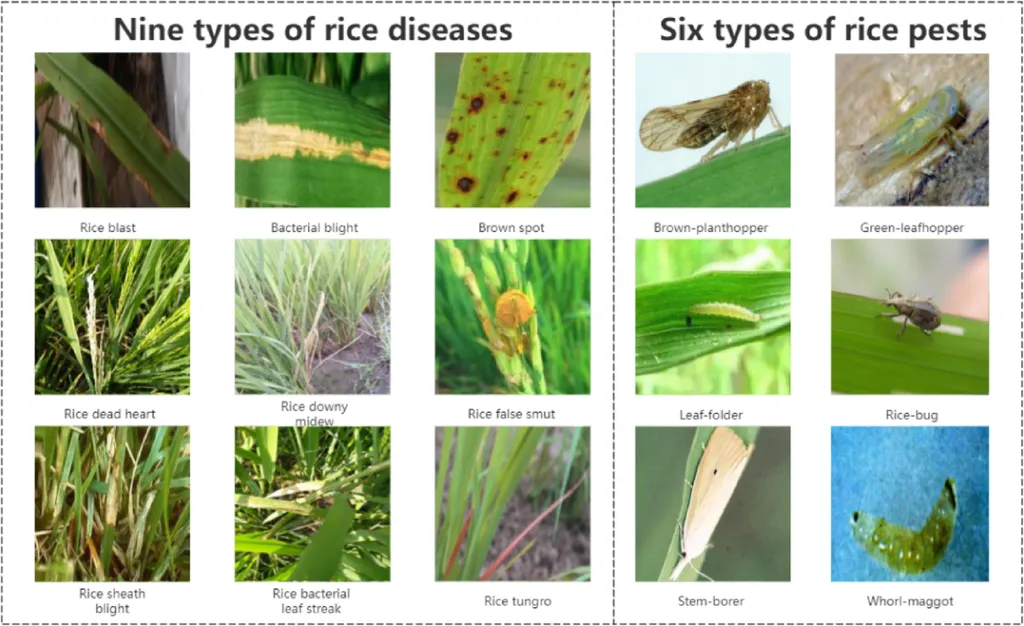
In the ever-evolving landscape of precision agriculture, a new breakthrough promises to revolutionize rice pest detection, offering farmers a powerful tool to safeguard their crops and boost yields. Researchers have developed CRRE-YOLO, an enhanced version of the YOLOv11 model, specifically designed to tackle the challenges of real-time rice pest detection. This innovation, detailed in a recent study published in *Applied Sciences*, integrates several advanced components to improve accuracy and efficiency, potentially reshaping the future of smart farming.
The CRRE-YOLO model addresses critical limitations in existing pest detection systems, such as small-object recognition, background interference, and computational efficiency. By incorporating the EIoU loss function, C2PSA_ELA module, RPAPAttention mechanism, and RIMSCConv module, the model achieves a remarkable balance between precision and speed. “Our goal was to create a model that not only performs accurately but also efficiently, making it practical for real-world applications,” said Guangzhuo Zhang, lead author of the study and a researcher at the School of Information Engineering, Zhejiang Ocean University.
The experimental results speak for themselves. On the RP11-Augmented dataset, CRRE-YOLO achieved a precision of 0.852, a recall of 0.787, and a mean average precision (mAP) of 83.6% at an intersection over union (IoU) threshold of 0.5. These metrics surpass those of the original YOLOv11 model by up to 7.8%, while also outperforming YOLOv8 and RT-DETR in accuracy. Impressively, the model maintains a lightweight architecture with only 2.344 million parameters and 6.1 billion floating-point operations per second (FLOPs), ensuring it can be deployed on edge devices for real-time monitoring.
The commercial implications for the agriculture sector are substantial. Accurate and efficient pest detection can lead to timely interventions, reducing crop losses and minimizing the use of pesticides. This not only benefits farmers economically but also promotes sustainable farming practices. “This technology has the potential to transform how we approach pest management in rice cultivation,” Zhang noted. “By providing real-time, actionable insights, farmers can make informed decisions that enhance productivity and sustainability.”
The integration of CRRE-YOLO into smart farming systems could also pave the way for more advanced agricultural technologies. As edge computing and Internet of Things (IoT) devices become more prevalent in farming, the model’s efficiency and accuracy make it an ideal candidate for deployment in these systems. This could lead to automated pest detection and management systems, further reducing the need for manual monitoring and intervention.
Looking ahead, the success of CRRE-YOLO highlights the potential for similar advancements in other areas of agriculture. The model’s architecture and components could be adapted for detecting pests in other crops, or even for identifying diseases and nutrient deficiencies. This versatility underscores the broader impact that deep learning and computer vision technologies can have on the future of farming.
As the agriculture sector continues to embrace technological innovations, CRRE-YOLO stands as a testament to the power of research and development in addressing real-world challenges. With its impressive performance metrics and practical applications, this model is poised to make a significant impact on the future of precision agriculture, offering farmers a powerful tool to protect their crops and enhance their livelihoods.