
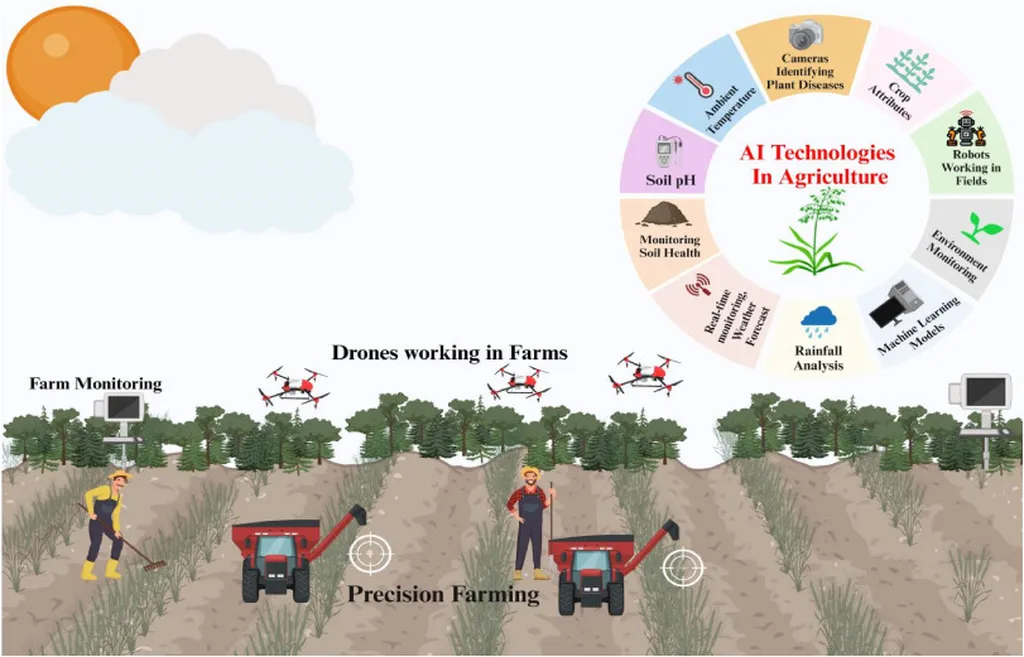
In an era where global agriculture faces unprecedented challenges, from climate change to market volatility, a new study offers a beacon of hope. Researchers have found that integrating digital and intelligent technologies can significantly bolster the resilience of the agricultural industry. The study, published in *Frontiers in Sustainable Food Systems*, analyzed data from 30 provinces in China over a decade, providing empirical evidence that could reshape agricultural strategies worldwide.
The research, led by Xiran Ke from the School of Economics and Management at Xiamen Nanyang University, reveals that for every one-unit increase in digital-intelligence integration, agricultural industry resilience increases by an average of 0.0865 units. This finding underscores the transformative potential of digital technologies in agriculture. “Digital infrastructure and the application of digital technologies are not just enhancements; they are necessities for building a resilient agricultural sector,” Ke explains.
The study highlights three key mechanisms through which digital-intelligence integration strengthens agricultural resilience. Firstly, it promotes agricultural technological advancements, enabling farmers to adopt innovative practices that improve yield and sustainability. Secondly, it fosters industry diversification, reducing the sector’s vulnerability to shocks by creating multiple revenue streams. Lastly, it alleviates labor misallocation, ensuring that human resources are utilized more efficiently.
The commercial implications of these findings are profound. For agricultural businesses, investing in digital technologies could mean the difference between weathering storms and succumbing to them. “In regions with lower levels of fiscal support for agriculture and higher levels of financial regulation, the impact of digital-intelligence integration on agricultural industry resilience is more significant,” Ke notes. This suggests that digital technologies can act as a safety net, particularly in areas where traditional support systems are lacking.
The study also provides a roadmap for policymakers. By prioritizing digital infrastructure development and promoting the adoption of digital technologies, governments can enhance the resilience of their agricultural sectors. This is not just about mitigating risks; it’s about seizing opportunities. As the global population grows and climate change intensifies, the demand for resilient and sustainable agriculture will only increase.
The research offers a glimpse into the future of agriculture, one where digital and intelligent technologies are not optional but essential. For the agriculture sector, this means a shift towards data-driven decision-making, automated processes, and smart farming practices. It’s a future that promises greater efficiency, sustainability, and resilience.
As we stand on the brink of this digital revolution, the question is no longer whether we should integrate digital-intelligence technologies into agriculture, but how quickly we can do so. The evidence is clear: the future of agriculture is digital, and the time to act is now.