
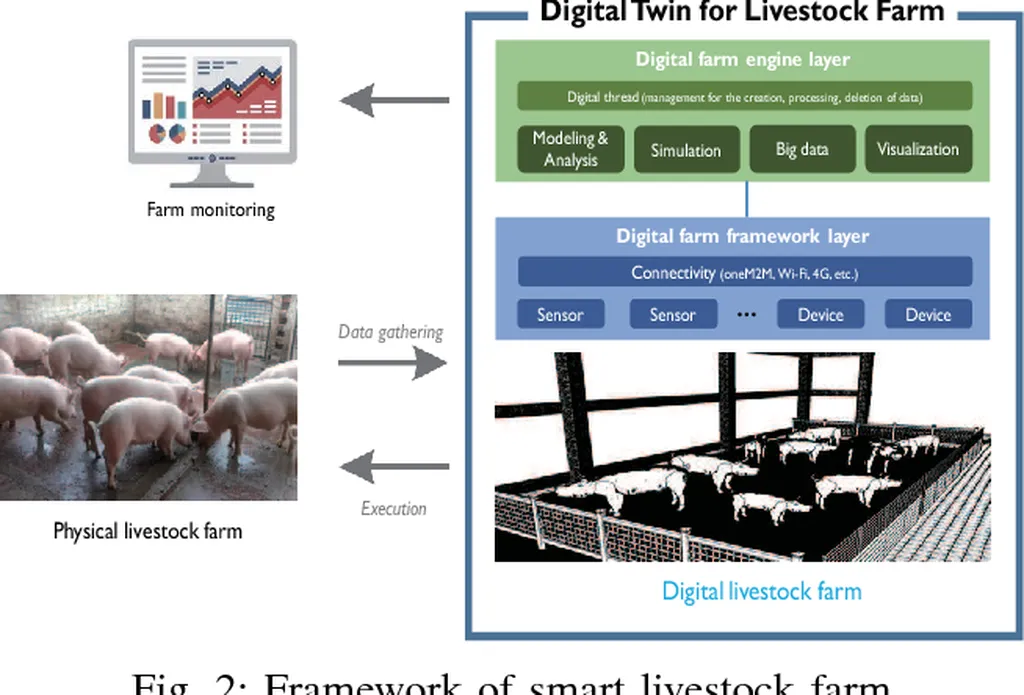
In the rapidly evolving landscape of smart agriculture, researchers are pushing the boundaries of digital twin technology to revolutionize pig farming. A recent study published in *Applied Sciences* introduces a groundbreaking method for creating lightweight, behavior-driven pig models that could significantly enhance the efficiency and accuracy of virtual farming systems. Led by Jun Yang from the College of Information and Intelligence at Hunan Agricultural University, this research addresses the unique challenges posed by the non-standard body configurations and complex behaviors of pigs, offering a promising solution for the agriculture sector.
The study proposes a binding method that combines lightweight skeletal design with automated weight allocation strategies. This approach optimizes skeletal layouts based on pig physiological structures and behavioral patterns, replacing manual processes with geometry-driven weight calculations. “Our method achieves a delicate balance between computational efficiency and the naturalness of animation,” Yang explains. “This is crucial for creating realistic and responsive digital twins that can accurately simulate pig behaviors.”
The research constructed a motion template library containing common behaviors such as walking and foraging, which were then tested and evaluated in simulation systems. The results are impressive: the method demonstrated a 95.2% reduction in computation time and a 91.7% reduction in memory storage space through weight matrix sparsification. Additionally, weight smoothness was maintained at 0.955, with cross-region weight leakage reduced from 15.3% to 2.1%. These improvements not only enhance the performance of digital twin models but also make them more accessible and practical for commercial use.
The implications for the agriculture sector are substantial. By providing a technically viable and economically feasible pathway for virtual modeling and intelligent interaction, this research could transform how farmers monitor and manage their livestock. “The ability to accurately simulate and predict pig behaviors can lead to more efficient farm management, improved animal welfare, and ultimately, higher productivity,” Yang notes. This could be particularly beneficial for large-scale pig farms, where real-time monitoring and data-driven decision-making are essential.
Looking ahead, this research opens up new possibilities for the integration of digital twin technology in smart agriculture. As the field continues to evolve, the development of more sophisticated and lightweight algorithms will be crucial. The study’s success in achieving high computational efficiency and accuracy sets a strong foundation for future advancements. “We believe that our method can be extended to other livestock models, paving the way for a more comprehensive and integrated approach to smart farming,” Yang adds.
In conclusion, this research represents a significant step forward in the application of digital twin technology to pig farming. By addressing the unique challenges of pig models and demonstrating the potential for widespread commercial impact, it offers a glimpse into the future of smart agriculture. As the agriculture sector continues to embrace digital transformation, innovations like these will play a pivotal role in shaping the industry’s trajectory.