
In the heart of India’s agricultural landscape, where rice paddies stretch as far as the eye can see, a silent battle rages. It’s not against drought or flood, but against diseases that threaten the country’s staple crop. Enter Felicita S. A. M., a researcher who has developed a novel approach to tackle this challenge, combining cutting-edge technologies to create a robust disease detection system.
The model, dubbed GRG-ViT, is a fusion of Vision Transformer (ViT), Generative Artificial Intelligence (GenAI), and Explainable Artificial Intelligence (XAI) techniques. It’s designed to capture intricate disease patterns in rice leaves, a task that has traditionally been challenging due to the subtle and varied nature of these patterns. “The Vision Transformer-based framework allows us to capture long-range spatial dependencies in leaf images,” Felicita explains, “This enhances the model’s ability to identify even the most subtle disease patterns.”
One of the key hurdles in training such models is class imbalance, where some diseases are underrepresented in the dataset. To overcome this, Felicita incorporated a GenAI-based synthetic data generation approach. This not only balances the training samples but also improves the model’s robustness. The model also employs a hybrid Rectified Linear Unit (ReLU)–Gaussian Error Linear Unit (GELU)-based activation mechanism for effective feature representation.
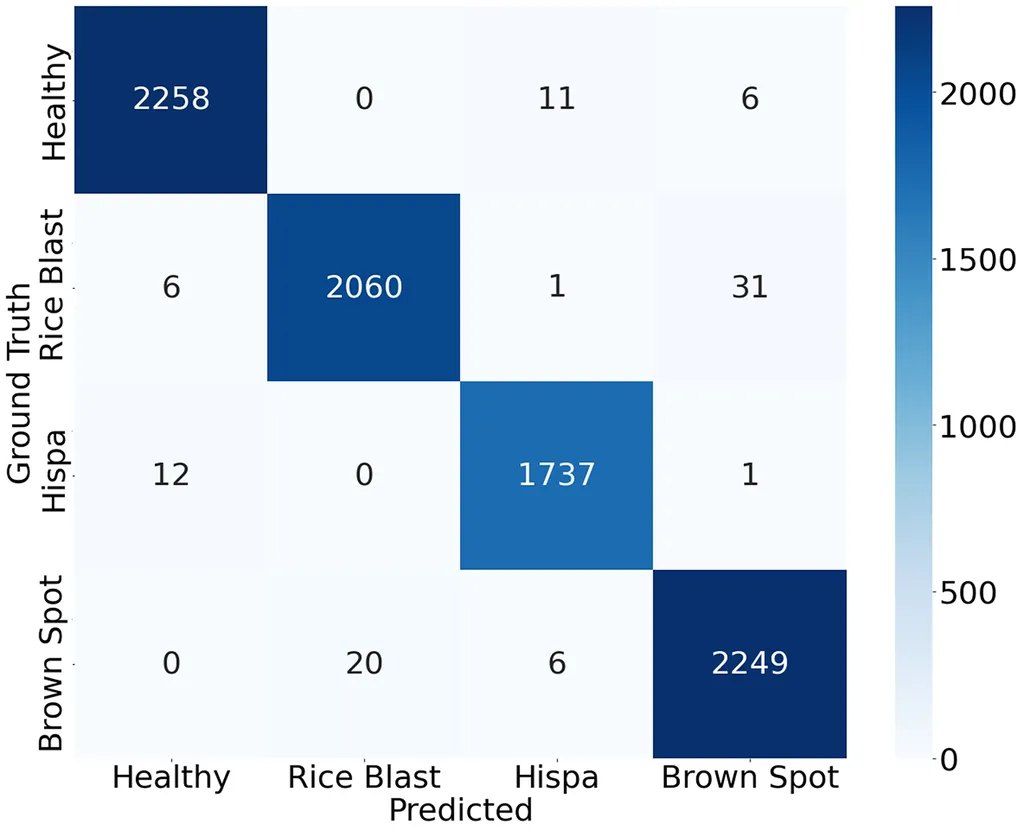
The results speak for themselves. The GRG-ViT model achieved an impressive overall accuracy of 96%, outperforming conventional approaches. Moreover, the incorporation of XAI methods like Gradient-weighted Class Activation Mapping (Grad-CAM) provides interpretability and transparency, highlighting the regions that impact the model’s decisions.
The commercial implications for the agriculture sector are substantial. Early and accurate disease detection can lead to timely interventions, reducing crop loss and increasing yield. This can translate to significant economic gains for farmers and the agricultural industry as a whole. As Felicita puts it, “This research showcases the blended power of ViT, GenAI, and XAI in producing reliable and high-performing results for rice disease detection in precision agriculture.”
Published in the journal ‘Frontiers in Plant Science’, this research could shape future developments in the field. It opens up possibilities for similar models to be developed for other crops, and for other technologies to be integrated into these models. As we move towards a future of smart farming, such innovations will be crucial in ensuring food security and sustainability.
In the words of Felicita, “This is just the beginning. The potential of these technologies in agriculture is vast and largely untapped.” And with researchers like her at the helm, the future of agriculture looks promising indeed.