
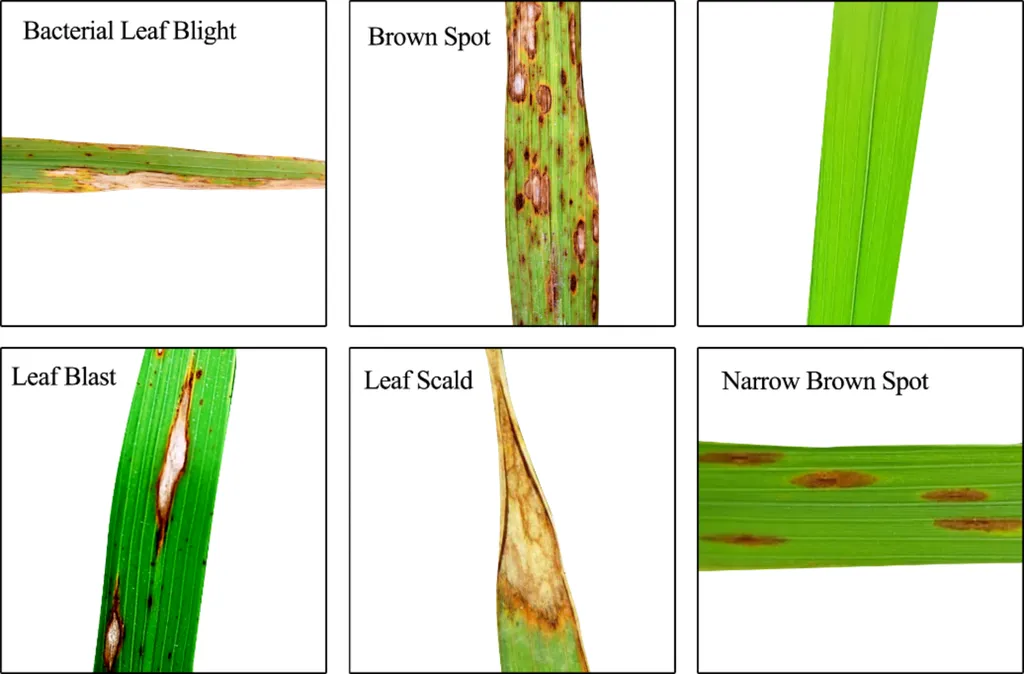
In the ever-evolving landscape of digital agriculture, researchers are continually seeking innovative solutions to monitor crop health efficiently and accurately. A recent study published in the journal *Sensors* introduces a promising advancement in this arena: a lightweight, edge-deployable framework designed specifically for intelligent rice disease monitoring. The research, led by Wei Liu from Harbin University of Commerce, presents a novel approach that could significantly impact the agriculture sector by balancing detection accuracy with computational cost.
Rice leaf diseases pose a substantial threat to crop yields, often manifesting as small, multi-scale lesions that are challenging to detect amidst variable illumination and cluttered backgrounds. Traditional monitoring methods frequently fall short in addressing these complexities, prompting the need for more sophisticated, yet lightweight, detection systems. Enter SCD-YOLOv11n, a model that aims to bridge this gap.
The SCD-YOLOv11n detector is designed with the unique challenges of rice disease monitoring in mind. By replacing the YOLOv11n backbone with a StarNet backbone and integrating a C3k2-Star module, the model enhances fine-grained, multi-scale feature extraction. This architectural innovation is complemented by a Detail-Strengthened Cross-scale Detection (DSCD) head, which improves the localization of small lesions. “Our goal was to create a model that could accurately identify and monitor rice diseases while being lightweight enough for edge deployment,” explains lead author Wei Liu.
The researchers further optimized the model through a DepGraph-based mixed group-normalization pruning rule and channel-wise feature distillation, ensuring that performance is maintained even after pruning. The results are impressive: the compressed model requires only 1.9 MB of storage, achieves 97.4% mAP@50 and 76.2% mAP@50:95, and attains a measured speed of 184 FPS under the tested settings. These metrics provide a robust benchmark for designing lightweight object detectors tailored for digital agriculture scenarios.
The implications of this research are far-reaching for the agriculture sector. By enabling real-time, accurate disease detection with minimal computational overhead, SCD-YOLOv11n could revolutionize crop monitoring practices. Farmers and agritech companies could deploy this lightweight model on edge devices, facilitating timely interventions and potentially saving millions in crop losses. “This technology has the potential to transform how we approach crop health monitoring, making it more accessible and efficient for farmers worldwide,” adds Liu.
As the field of digital agriculture continues to evolve, the development of lightweight, intelligent monitoring systems like SCD-YOLOv11n will play a pivotal role. The research, published in *Sensors* and led by Wei Liu from Harbin University of Commerce, sets a new standard for balancing accuracy and computational efficiency, paving the way for future innovations in smart farming. The study not only addresses current challenges but also inspires further exploration into the integration of advanced technologies in agriculture, promising a more sustainable and productive future for the sector.