
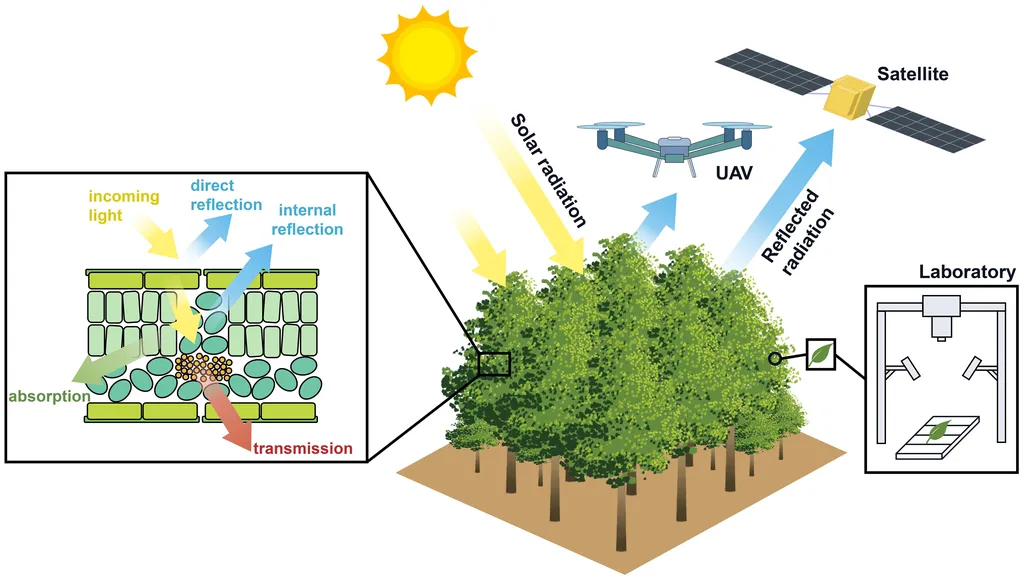
In the ever-evolving landscape of precision agriculture, a groundbreaking study published in *Remote Sensing* is set to revolutionize how we approach hyperspectral image (HSI) target detection. The research, led by Weile Han from the School of Geomatics Science and Technology at Nanjing Tech University, introduces a novel diffusion model that significantly enhances background suppression in HSI, a critical factor for improving detection accuracy in agricultural applications.
Hyperspectral imaging has long been a valuable tool in agriculture, enabling farmers and researchers to monitor crop health, detect pests, and optimize resource use. However, the complex backgrounds in these images have posed a persistent challenge, limiting the effectiveness of target detection algorithms. Han’s research addresses this issue head-on by proposing a diffusion model that generates multivariate Gaussian-distributed background noise samples and integrates them into the forward diffusion process. This innovative approach trains a denoising network to suppress background noise effectively, thereby improving detection performance.
“The complex background of the scene severely restricts the further improvement of hyperspectral target detection performance,” Han explains. “Our method constructs multivariate Gaussian-distributed background noise samples and introduces them into the forward diffusion process of the diffusion model. This allows us to train a denoising network that can effectively suppress the background, thus improving the detection performance.”
One of the standout features of this research is the background noise extraction strategy based on spatial–spectral centre weighting. This strategy combines superpixel segmentation techniques to fuse local spatial neighbourhood information, ensuring accurate background noise extraction. The results are impressive, with experiments conducted on four publicly available HSI datasets demonstrating state-of-the-art background suppression and competitive detection performance.
For the agriculture sector, the implications are profound. Accurate target detection in hyperspectral images can lead to more precise crop monitoring, early pest detection, and better resource management. This, in turn, can enhance yield predictions, reduce input costs, and promote sustainable farming practices. As precision agriculture continues to evolve, the ability to suppress background noise effectively will be crucial for maximizing the potential of hyperspectral imaging technologies.
The study’s evaluation using ROC curves and AUC-family metrics further underscores its effectiveness, providing a robust framework for future developments in the field. As Weile Han and his team continue to refine their approach, the agricultural industry can look forward to more accurate and reliable detection methods, paving the way for smarter, more efficient farming practices.
Published in *Remote Sensing* and led by Weile Han from the School of Geomatics Science and Technology at Nanjing Tech University, this research marks a significant step forward in the application of hyperspectral imaging in agriculture. The potential for this technology to transform the way we monitor and manage crops is immense, and the future of precision agriculture looks brighter than ever.