
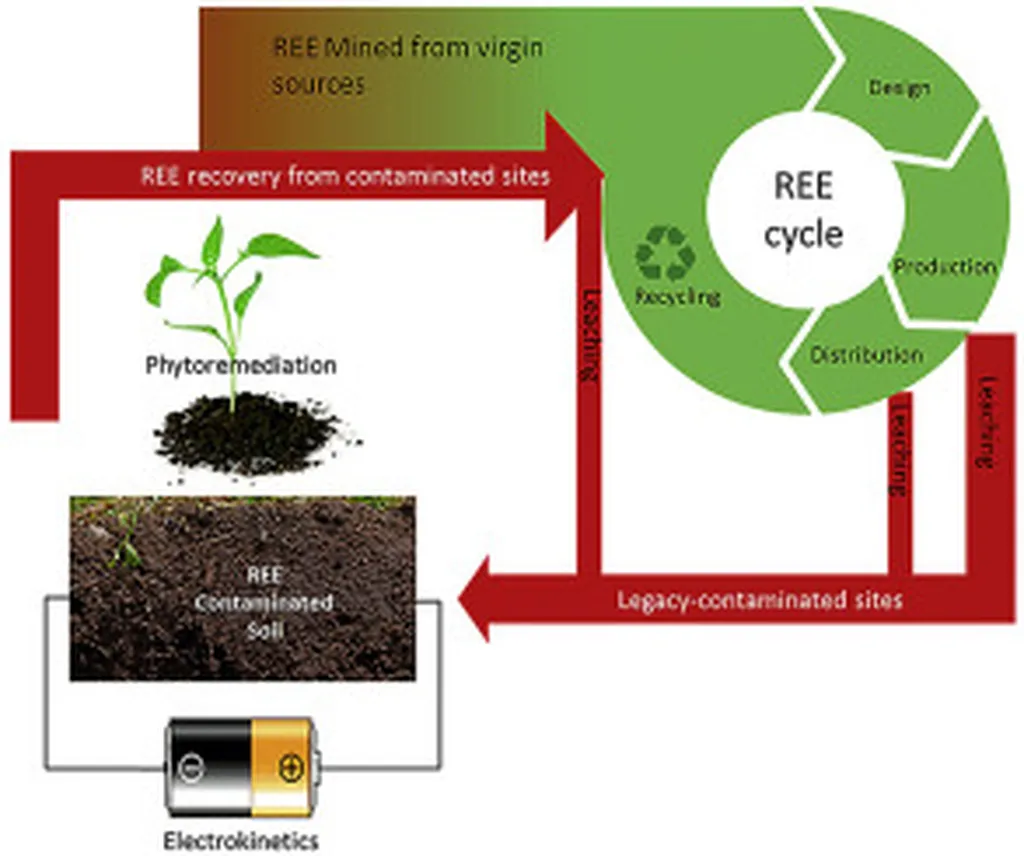
In the quest to mitigate the pervasive issue of cadmium (Cd) contamination in soils, a novel approach is emerging that could revolutionize the agriculture sector’s phytoremediation strategies. A recent study published in *Frontiers in Plant Science* explores the potential of rare earth elements (REEs) to enhance the efficiency of hyperaccumulator plants in removing Cd from contaminated soils. This research, led by An Shi of the Hainan Key Laboratory of Arable Land Conservation, offers a promising avenue for improving the sustainability and effectiveness of phytoremediation.
Cadmium contamination poses significant ecological and health risks, often limiting agricultural productivity and food safety. Traditional phytoremediation methods, which use hyperaccumulator plants to absorb and concentrate heavy metals from the soil, have shown promise but are often hindered by the plants’ low biomass and limited tolerance to metal stress. Enter REEs, particularly lanthanum (La³⁺) and cerium (Ce³⁺), which have been found to stimulate plant growth, modulate phytohormone signaling, and enhance root development. These elements can also modify soil chemical conditions and influence rhizosphere microbial communities, all of which contribute to improved Cd mobilization and uptake.
“REEs have a multifaceted impact on both the plant and soil environments,” explains lead author An Shi. “They not only enhance the physiological responses of hyperaccumulator plants but also alter the soil chemistry and microbial dynamics in ways that facilitate Cd remediation.”
The study synthesizes current evidence to propose a conceptual framework that integrates REE–plant–soil–microbe interactions. This framework highlights how REEs can induce systemic endocytosis in plants, providing an additional pathway for Cd uptake. By understanding these interactions, researchers aim to optimize the use of REEs to boost the efficiency of phytoremediation.
The commercial implications for the agriculture sector are substantial. Enhanced phytoremediation techniques could lead to more efficient and cost-effective methods for cleaning up Cd-contaminated soils, thereby improving land productivity and ensuring food safety. Farmers and agricultural businesses could benefit from reduced soil contamination risks, leading to higher crop yields and better market opportunities.
However, the research also underscores key uncertainties and research needs, particularly in verifying the mechanisms, ensuring ecological safety, and assessing field applicability. As An Shi notes, “While the potential is promising, further studies are needed to fully understand the long-term effects and ecological implications of using REEs in phytoremediation.”
This groundbreaking research opens new avenues for developing innovative phytoremediation strategies that could transform the agriculture sector. By leveraging the unique properties of REEs, scientists and farmers alike may soon have a powerful new tool to combat soil contamination and promote sustainable agricultural practices.