
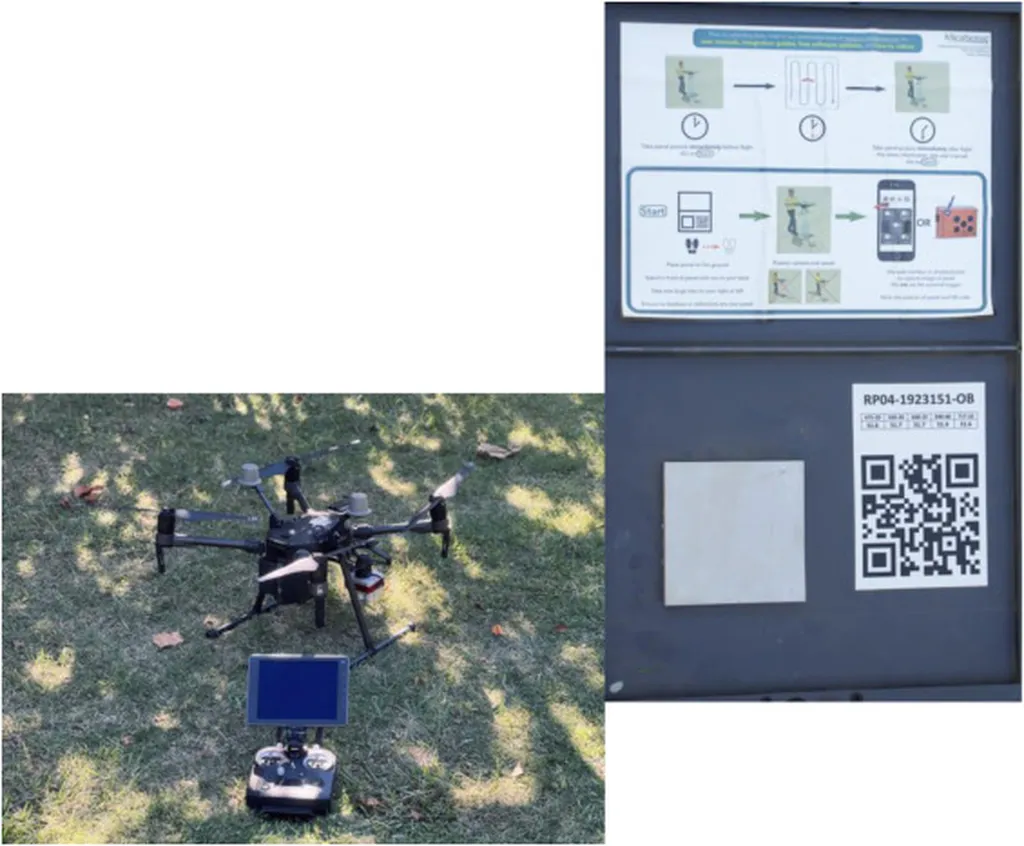
In the ever-evolving landscape of precision agriculture, a groundbreaking study published in *Agronomy* is set to revolutionize how farmers monitor and manage cotton crops. Led by Shuhan Huang from the Xinjiang Key Laboratory of Soil and Plant Ecological Processes at Xinjiang Agricultural University, the research introduces a novel method for estimating cotton aboveground biomass (AGB) using a combination of multispectral (MS) imagery from unmanned aerial vehicles (UAVs) and advanced machine learning techniques.
The study highlights the critical role of accurate AGB estimation in analyzing cotton growth variations and guiding agricultural management practices. Traditional methods often fall short in capturing the complex, nonlinear relationships between biomass and its relevant variables. However, Huang’s research demonstrates that integrating spectral, textural features, and canopy height (CH) derived from UAV data can significantly enhance the precision of AGB estimation.
“By combining these multiple features and employing a convolutional neural network (CNN), we were able to achieve a remarkable level of accuracy in estimating cotton AGB,” Huang explained. The CNN model outperformed conventional machine learning algorithms like Bayesian Ridge Regression (BRR) and Random Forest Regression (RFR), achieving an R² value of 0.80, with an RMSE of 0.17 kg·m⁻² and an MAE of 0.11 kg·m⁻².
The implications for the agriculture sector are profound. Precise AGB estimation enables farmers to make data-driven decisions, optimizing resource allocation and improving crop yields. “This method provides a robust framework for monitoring crop growth and improving field management,” Huang added. The integration of UAV technology and deep learning models offers a scalable and efficient solution for large-scale agricultural operations, potentially transforming the way farmers approach crop monitoring and management.
As the agriculture industry continues to embrace technological advancements, this research paves the way for future developments in precision agriculture. The fusion of multispectral imagery, textural features, and advanced machine learning techniques holds promise for a wide range of crops beyond cotton. By leveraging these innovative approaches, farmers can enhance productivity, sustainability, and profitability, ultimately shaping the future of agriculture.
The study, published in *Agronomy*, represents a significant step forward in the field of agritech, offering valuable insights and tools for farmers and researchers alike. As the agriculture sector continues to evolve, the integration of cutting-edge technology and data-driven methodologies will be crucial in addressing the challenges of feeding a growing global population while promoting sustainable practices.