
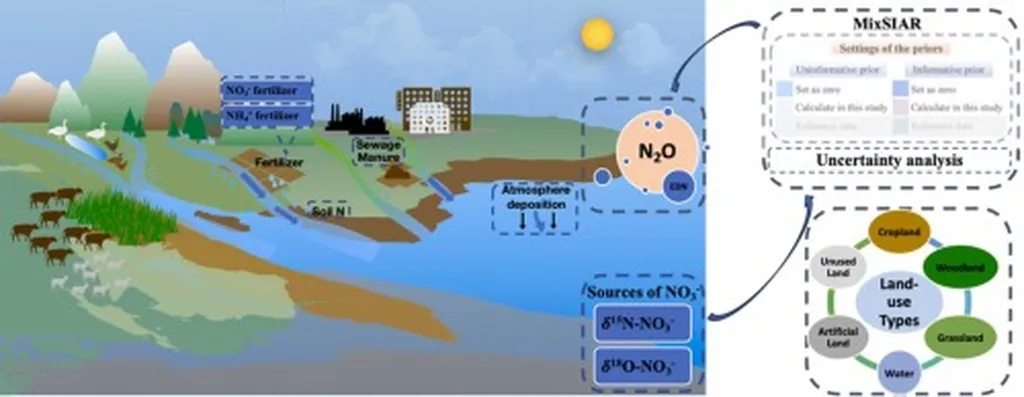
In the quest to mitigate river nitrogen pollution, scientists have long grappled with the challenge of accurately modeling nitrogen concentration dynamics. Traditional statistical models often fall short in explanatory power, while process-based models demand extensive data. A recent study published in *Water Research X* offers a promising solution, integrating landscape configuration metrics into a Bayesian mixed-effects model to bridge this predictive gap.
The research, led by Haojie Han from the State Key Laboratory of Soil and Sustainable Agriculture at the Chinese Academy of Sciences, focuses on the Qinhuai River watershed. The study introduces a new model, BME_CONFI, which captures spatiotemporal dependencies and incorporates key landscape configuration metrics. This approach marks a significant departure from conventional methods that primarily focus on landscape composition, neglecting the spatial arrangement of land uses.
“Our model achieves high predictive performance, with an R2 value ranging from 66% to 69% and an RMSE between 0.207 and 0.218,” Han explains. “This outperforms models based on composition alone, providing a more robust and interpretable framework.”
The study reveals that human activity intensity (NLI) and impervious surface aggregation (PLADJ_Impervious) positively influence river nitrogen concentrations, while water landscape connectivity (IJI_Water) has a negative effect. These findings underscore the importance of considering landscape configuration in nutrient transport and pollution mitigation strategies.
For the agriculture sector, the implications are substantial. Accurate modeling of nitrogen dynamics can inform targeted, landscape-based strategies to reduce pollution. This can lead to more sustainable agricultural practices, minimizing the environmental impact while maintaining productivity. “By understanding the spatial arrangement of land uses, we can design more effective mitigation strategies that are both practical and environmentally sound,” Han adds.
The research also bridges the gap between oversimplified statistical approaches and complex process models, offering a practical tool for policymakers and environmental managers. This integrated approach could shape future developments in landscape ecology and water resource management, fostering a more holistic understanding of nutrient dynamics.
As the agriculture sector continues to grapple with the challenges of sustainable nutrient management, this study provides a valuable framework for developing targeted strategies. By leveraging landscape configuration metrics and advanced modeling techniques, the agriculture industry can move towards more effective and environmentally friendly practices.