
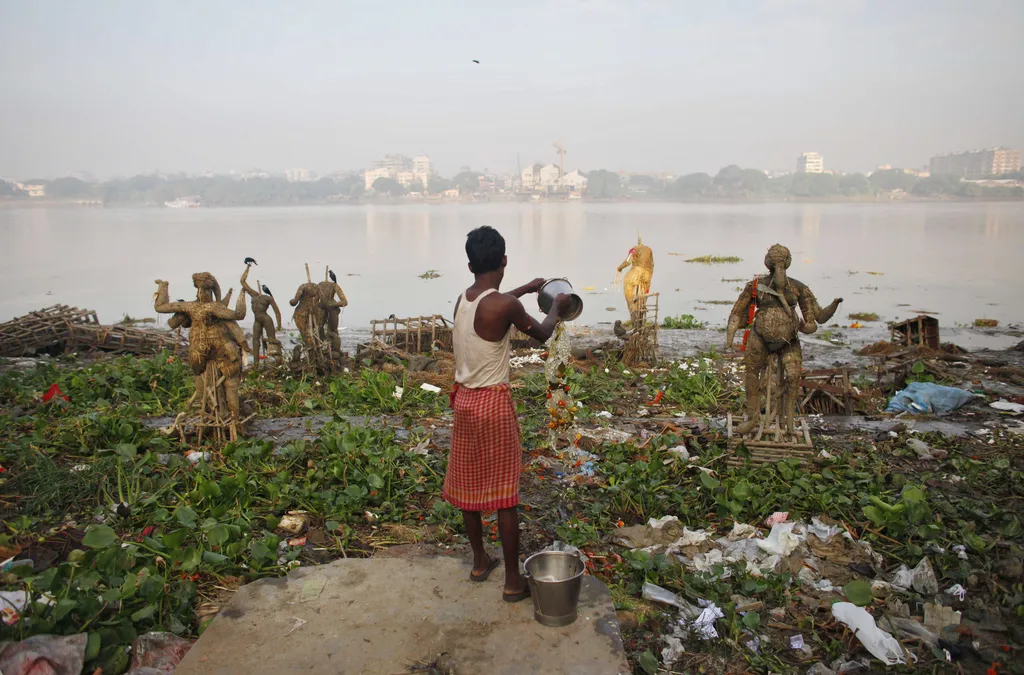
In the heart of India, the Ganga River flows not just as a lifeline for millions but as a vital artery for agriculture, industry, and cultural heritage. Yet, the relentless pace of urbanization and unchecked waste discharge has cast a shadow over its health, threatening the very sectors that depend on it. A recent study published in *Cleaner Water* sheds light on the seasonal water quality shifts of the Ganga River as it winds through Patna’s urban drains, offering critical insights that could reshape water management strategies and agricultural practices in the region.
Led by Bhawana Raj from the Department of Environmental Science at the Central University of South Bihar, the research employs Geographic Information Systems (GIS) to map water quality indices and identify pollution hotspots along the river. This spatial assessment is complemented by multivariate statistical techniques, including Principal Component Analysis (PCA) and Pearson Correlation Matrix (PCM), which help distinguish between natural and human-induced contamination sources.
The study collected 20 water samples each during the summer and winter seasons of 2022 and 2023, analyzing a range of physicochemical parameters such as alkalinity, turbidity, chloride, pH, electrical conductivity, and dissolved oxygen, among others. The findings reveal the seasonal variations in water quality, which are crucial for assessing the river’s suitability for irrigation.
“Understanding these seasonal shifts is vital for farmers who rely on the Ganga for their livelihoods,” Raj explains. “By identifying pollution hotspots and understanding the sources of contamination, we can develop targeted strategies to mitigate the impact on agriculture.”
The research also calculates key irrigation indices such as the Sodium Adsorption Ratio (SAR), Sodium percentage (%Na), and Kelly’s Ratio (KR). These indices are critical for determining the suitability of river water for agricultural use, as high levels of sodium and other salts can degrade soil quality and reduce crop yields over time.
For the agriculture sector, the implications are profound. The study provides a scientific basis for policymakers to formulate drain-specific water management strategies, ensuring that the Ganga River remains a viable resource for irrigation. This could lead to more sustainable farming practices, reduced soil degradation, and ultimately, higher crop yields.
“This research is a stepping stone towards more informed decision-making in water management,” Raj adds. “It highlights the need for continuous monitoring and adaptive strategies to protect our vital water resources.”
As the world grapples with the challenges of climate change and urbanization, studies like this one are more important than ever. They offer a roadmap for balancing the needs of urban development with the preservation of natural resources, ensuring that the Ganga River continues to support the livelihoods and cultural heritage of millions.
With the findings published in *Cleaner Water* and led by Bhawana Raj from the Central University of South Bihar, this research not only advances our understanding of water quality dynamics but also paves the way for innovative solutions in water management and agricultural sustainability.