
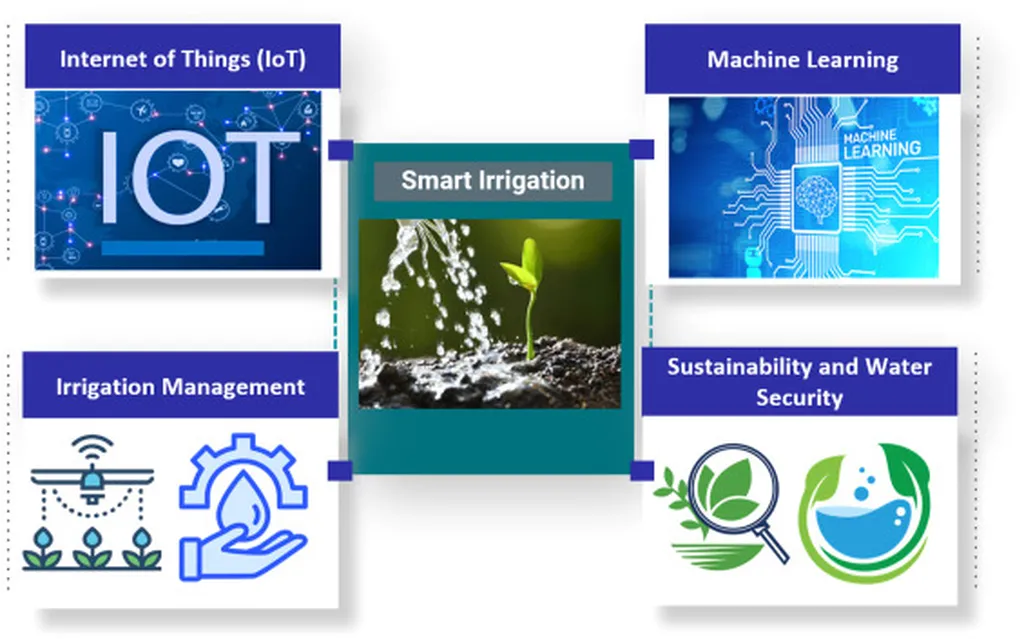
In a world grappling with water scarcity and climate change, farmers and agronomists are constantly seeking innovative ways to optimize irrigation and conserve water. A groundbreaking study published in *Smart Agricultural Technology* offers a promising solution: a machine learning framework that estimates the actual crop coefficient (Kc−act) without the need for field sensors. This development could revolutionize water management in agriculture, enhancing efficiency and sustainability.
The actual crop coefficient is a crucial metric that helps determine the amount of water crops need, based on their growth stage and environmental conditions. Accurate estimation of Kc−act is essential for optimizing irrigation strategies, improving water use efficiency, and building resilience in agricultural systems. However, traditional methods often rely on expensive field sensors, which can be prohibitive for many farmers.
Enter Federico Amato, a researcher from the Department of Engineering at the University of Palermo, and his team. They have developed a machine learning model that integrates ERA5-L reanalysis data to provide accurate Kc−act estimates, even in the absence of complete datasets. “Our model offers a scalable solution to monitor and manage water resources in agriculture, reducing the dependency on expensive equipment,” Amato explains.
The framework was tested on a diverse range of crops, including wheat, maize, citrus, and olives, demonstrating its adaptability to different agricultural contexts. The process involves data preprocessing, actual evapotranspiration (ETa) prediction using a Random Forest model, and seasonal decomposition to regularise the data. The results are impressive, with root mean square error (RMSE) values as low as 0.073 for citrus orchards and 0.143 for olive groves, significantly improving upon traditional methods.
The commercial implications of this research are substantial. By providing a cost-effective and accurate tool for estimating Kc−act, farmers can optimize their irrigation strategies, leading to improved crop yields and reduced water waste. This is particularly relevant in regions facing water scarcity and changing climatic conditions. As Amato puts it, “This tool offers a practical way to optimize irrigation strategies and improve the efficiency of water use, contributing to more sustainable agricultural practices.”
The study also highlights the variations in Kc−act values influenced by climatic and field management conditions, offering valuable insights for farmers and agronomists. By understanding these variations, they can make informed decisions about irrigation, ultimately enhancing the resilience of their crops and agricultural systems.
This research not only addresses immediate challenges in water management but also paves the way for future developments in precision agriculture. As machine learning and data-driven approaches become more prevalent, we can expect to see further innovations in crop monitoring, irrigation management, and resource optimization. The work of Amato and his team is a testament to the power of technology in driving sustainable agriculture, offering hope for a future where water is used more efficiently and effectively.
In the quest for sustainable agriculture, every innovation counts. This study, published in *Smart Agricultural Technology* and led by Federico Amato from the Department of Engineering at the University of Palermo, is a significant step forward, offering a practical, scalable, and cost-effective solution for optimizing irrigation and conserving water. As we face the challenges of climate change and water scarcity, such advancements are not just welcome but essential.