
In a significant stride towards enhancing crop monitoring and management, researchers have developed a novel model that promises to revolutionize the prediction of winter wheat stem dry biomass (SDB). This advancement, detailed in a study published in *Artificial Intelligence in Agriculture*, addresses a longstanding challenge in agriculture: the accurate and timely estimation of biomass across different growth stages and environmental conditions.
The new semi-mechanistic model, dubbed PVWheat-SDB, leverages phenological variables (PVs) and remote-sensed canopy vegetation indices (VIs) to predict SDB with remarkable precision. Traditional models often falter due to their sensitivity to crop growth phases, limiting their applicability. However, the PVWheat-SDB model overcomes these limitations by integrating normalized difference red edge (NDRE) and accumulated growing degree days (AGDD), offering a robust solution for farmers and agronomists.
“We aimed to create a model that could accurately predict stem biomass across various growth stages and different planting conditions,” said Weinan Chen, lead author of the study and a researcher at the State Key Laboratory of Loess Science, College of Geological Engineering and Geomatics, Chang’an University, and the Key Laboratory of Quantitative Remote Sensing in Agriculture of Ministry of Agriculture and Rural Affairs, Information Technology Research Center, Beijing Academy of Agriculture and Forestry Sciences. “The results demonstrate that our model not only meets this goal but also shows significant potential for future applications in precision agriculture.”
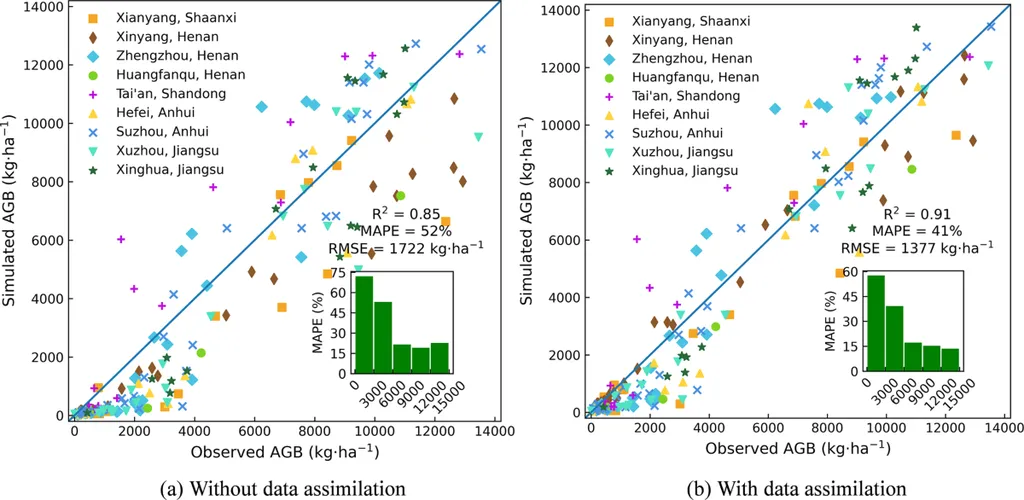
The model’s efficacy was validated using field spectral reflectance data and unmanned aerial vehicle (UAV) hyperspectral images, yielding impressive performance metrics. With R2 values of 0.88 and 0.82, respectively, the model showcased its reliability and transferability. Moreover, the PVWheat-SDB model can estimate current SDB and predict future biomass at subsequent phenological stages, providing farmers with invaluable insights for decision-making.
One of the most compelling aspects of this research is its potential to enhance agricultural productivity and sustainability. By enabling accurate biomass predictions, farmers can optimize resource allocation, improve crop management practices, and ultimately increase yields. “This model has the potential to transform how we monitor and manage crops,” Chen added. “It offers a scalable and cost-effective solution that can be integrated into existing agricultural systems, benefiting both small-scale farmers and large-scale agribusinesses.”
The study also highlights the importance of incorporating multiple growth stages in the model, as it significantly improves prediction accuracy, particularly during reproductive stages. This finding underscores the need for continuous monitoring and adaptive management strategies in modern agriculture.
As the agricultural sector grapples with the challenges posed by climate change and resource scarcity, innovative solutions like the PVWheat-SDB model are more critical than ever. By harnessing the power of remote sensing and artificial intelligence, researchers are paving the way for a more resilient and efficient agricultural future. This research not only advances our understanding of crop growth dynamics but also sets the stage for future developments in precision agriculture, offering hope for a more sustainable and productive farming landscape.