
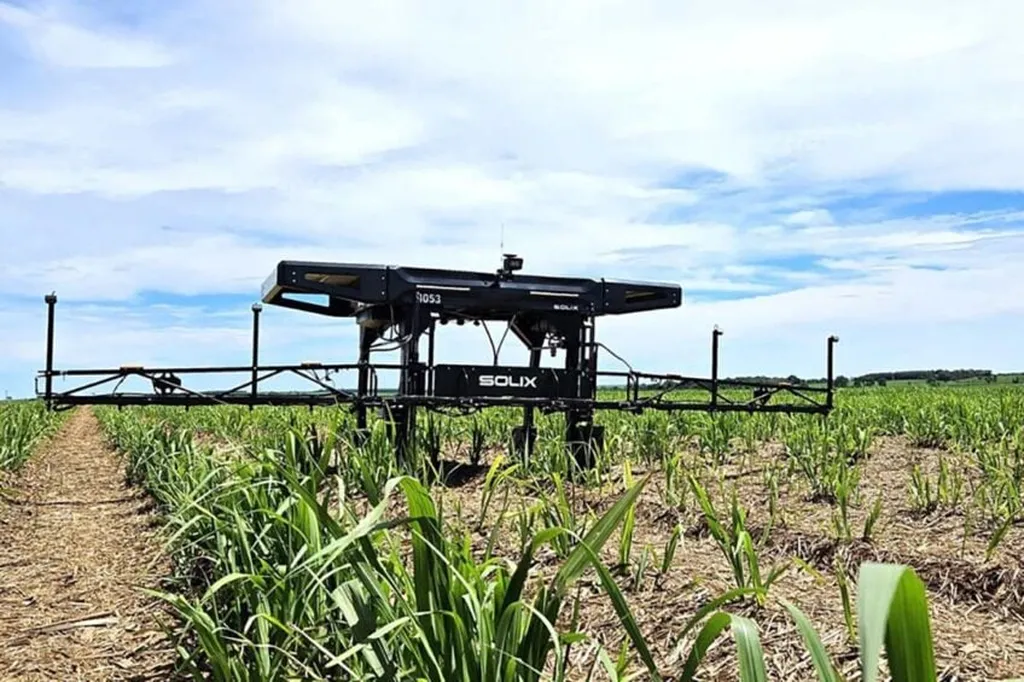
In the heart of modern agriculture, where precision and sustainability are paramount, a groundbreaking study is making waves. Researchers have successfully integrated artificial intelligence (AI) and robotics to revolutionize pest detection and soil health monitoring in sugarcane fields. The study, led by M. Abinaya from the Department of Computer Science and Engineering at Karpagam Academy of Higher Education, was recently published in the *International Journal of Computational Intelligence Systems*.
The research combines the power of You Only Look Once Version 8 Medium (YOLOv8m) for pest identification and Deep Q-Network (DQN) for soil health monitoring. This innovative approach leverages high-resolution images captured by drones and data collected by autonomous soil robots (ASR) equipped with various sensors. The YOLOv8m model excels in recognizing and categorizing pests, even in challenging environments, while the DQN algorithm processes soil data to monitor health parameters such as pH, moisture, nutrient content, and temperature.
“Our integrated approach significantly enhances the accuracy of pest detection compared to traditional techniques,” Abinaya explained. “By using AI and robotics, we can provide detailed and close-up soil health monitoring, which is crucial for sustainable agriculture.”
The study focuses on identifying major pests like early shoot borers, black bugs, red rust, bacterial blight, stem borers, whiteflies, red rot, leaf spot, mite insects, and crown mealy bugs. The ASRs, equipped with reinforcement learning, navigate autonomously, adapting to various field conditions and prioritizing areas with poor soil health and pest detection hotspots.
The commercial implications for the agriculture sector are substantial. Enhanced pest detection and soil health monitoring can lead to more informed decision-making, optimizing pest control policies and soil handling measures. This, in turn, contributes to improved sugarcane crop health and productivity.
“This research shows the feasibility of AI/ML and robotics to transform agricultural policies,” Abinaya added. “We are providing scalable, cost-efficient, and intelligent pest control solutions for sustainable agriculture.”
The study’s findings highlight the potential for AI and robotics to reshape the future of agriculture. As these technologies continue to evolve, they offer promising avenues for enhancing crop productivity and sustainability. The integration of YOLOv8m and DQN models sets a new standard for intelligent pest control and soil monitoring, paving the way for smarter, more efficient agricultural practices.