
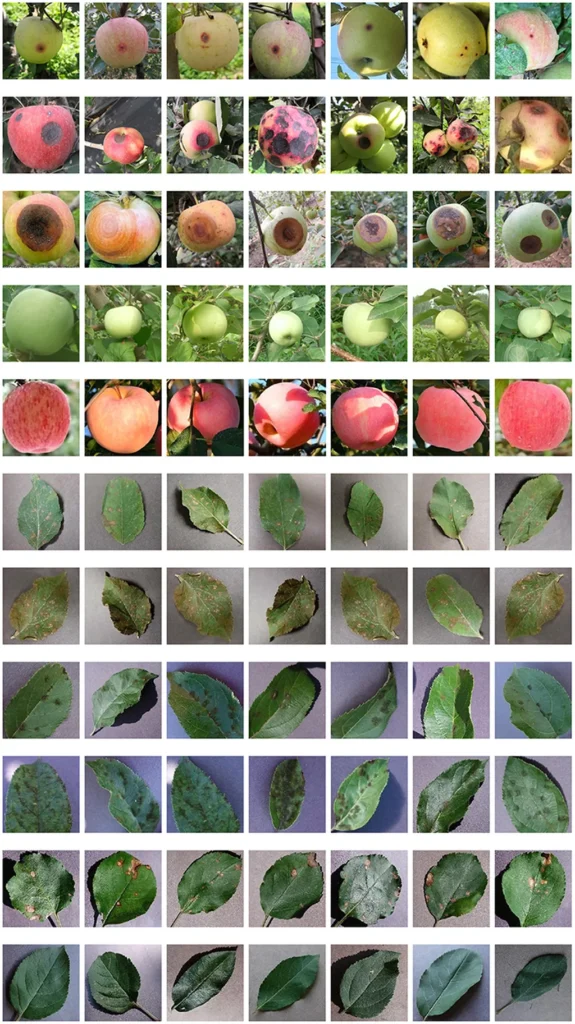
In the ever-evolving landscape of precision agriculture, early and accurate detection of plant diseases is a game-changer. A recent study published in *BMC Plant Biology* introduces a novel deep learning approach that promises to revolutionize apple leaf disease detection, offering significant commercial benefits for the agriculture sector.
The research, led by Aniket K. Shahade from the Symbiosis Institute of Technology, Pune Campus, presents a hybrid architecture that combines enhanced spatial attention with edge-aware feature extraction. This innovative model is designed to improve disease classification robustness, addressing the critical challenge of complex field conditions and subtle symptom variations that often degrade model performance.
The proposed model integrates a multi-scale feature fusion module to capture both local lesion patterns and global contextual cues. Additionally, a lightweight attention mechanism dynamically prioritizes disease-relevant regions, making it particularly effective in detecting early-stage infections. “Our system excels in identifying subtle scab lesions, showing a 15% higher precision compared to existing methods,” Shahade explained. This level of accuracy is crucial for farmers, as early detection can significantly reduce crop losses and improve yield quality.
The model’s performance is impressive, achieving a 96.7% classification accuracy across six disease categories. This is a notable improvement over baseline models like EfficientNet-B4 (94.1%) and ResNet-50 (93.8%). Moreover, with only 3.2 million parameters, the model maintains practical deployment potential for edge devices in orchard environments. “We’ve balanced accuracy and computational efficiency to ensure real-world applicability,” Shahade added.
The commercial impacts of this research are substantial. Accurate and early disease detection can lead to more targeted and efficient use of pesticides, reducing costs and environmental impact. It also enables farmers to make data-driven decisions, optimizing their resources and improving overall productivity. As the agriculture sector increasingly adopts technology, such advancements are pivotal in shaping the future of smart farming.
This study not only addresses key limitations in current vision-based plant disease detection systems but also paves the way for future developments. The integration of edge-enhanced dual branch convolutional neural networks (CNNs) with adaptive attention mechanisms could inspire further innovations in agricultural technology. As researchers continue to refine these models, we can expect even more sophisticated tools that will empower farmers to manage their crops more effectively.
In the realm of plant pathology and computer vision, this research marks a significant milestone. It underscores the potential of deep learning in transforming traditional agricultural practices, making them more precise, efficient, and sustainable. As the agriculture sector continues to evolve, such technological advancements will be instrumental in meeting the growing demand for food while minimizing environmental impact.