
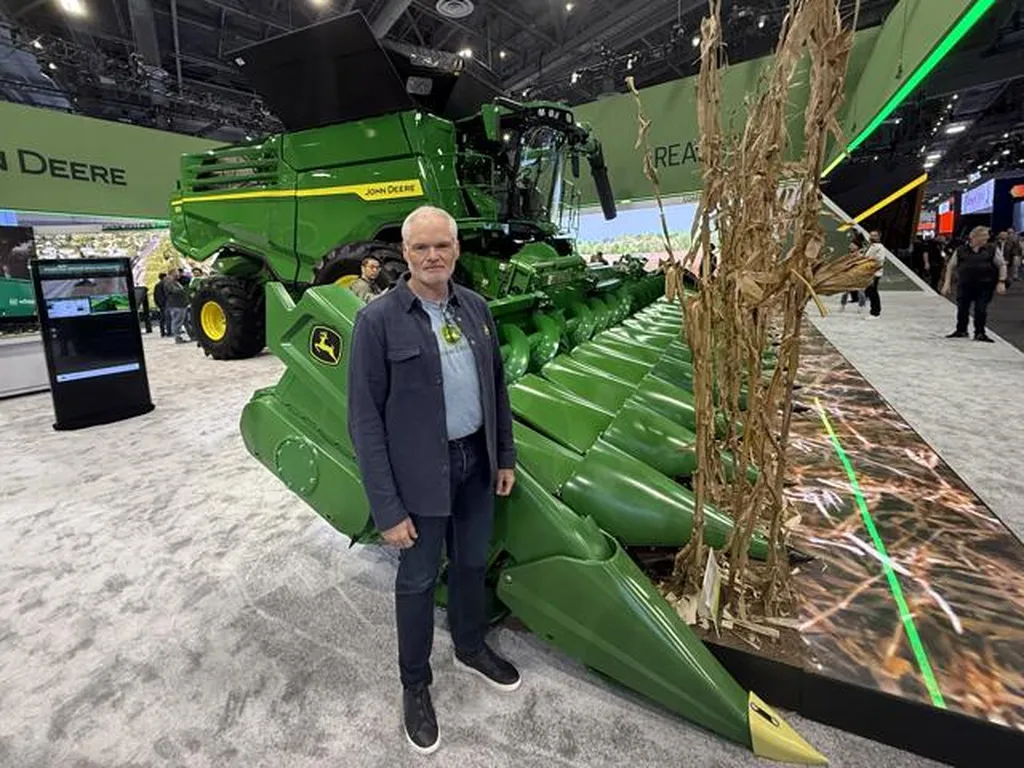
At CES 2026, held in the sprawling West Hall of the Las Vegas Convention Center, U.S. agricultural equipment giant Deere captured the imagination of attendees with its latest innovation: the X9, a colossal combine harvester that made its debut at the event. Towering at about four meters in height and stretching nearly 10 meters in length, the X9 is not just impressive in size but also in its technological advancements, particularly its autonomous driving capabilities.
The X9 harvester is equipped with a global positioning system and multiple cameras, enabling it to autonomously navigate fields and determine the most efficient routes for harvesting crops. Visitors to the Deere booth had the opportunity to test a harvester simulator, where they manually steered and harvested virtual crops. The challenge of timing turns and avoiding previously harvested areas became evident as many struggled with the task. However, activating the “autonomous mode” transformed the experience, as the harvester smoothly and efficiently completed the work on its own. A Deere representative highlighted that autonomous operation can boost crop yields by 20 to 30 percent compared to manual driving.
Deere’s participation in CES underscores a broader trend of integrating artificial intelligence into labor-intensive industries like agriculture and construction. With the average age of U.S. farmers now at 58, AI-equipped machinery is seen as a critical solution to labor shortages exacerbated by an aging workforce. Since 2019, Deere has been a regular at CES, showcasing its commitment to innovation and addressing the evolving needs of the agricultural sector.
The construction industry, also facing significant labor challenges, presented its own AI advancements at CES 2026. Doosan Bobcat unveiled AI-based voice command technology for its compact construction machinery. Demonstrations showed operators using voice commands to control various functions, such as turning on lights, adjusting engine speed, and managing attachments. This technology, capable of handling over 50 functions, aims to make heavy machinery more accessible to beginners, enhancing efficiency and ease of use.
Similarly, global heavy equipment manufacturer Caterpillar showcased its conversational AI integrated into machinery. On-site inquiries, such as identifying the most worn component, were met with immediate responses from the AI system. Caterpillar plans to further develop this technology to operate offline, eliminating the need for an internet connection.
The innovations presented at CES 2026 highlight a transformative shift towards AI and autonomous technologies in industries critical to global infrastructure and food security. As labor shortages continue to pose challenges, these advancements offer promising solutions to enhance productivity, efficiency, and accessibility. The integration of AI into agricultural and construction equipment not only addresses immediate workforce issues but also paves the way for a future where technology and human expertise converge to meet the demands of an ever-evolving world.