
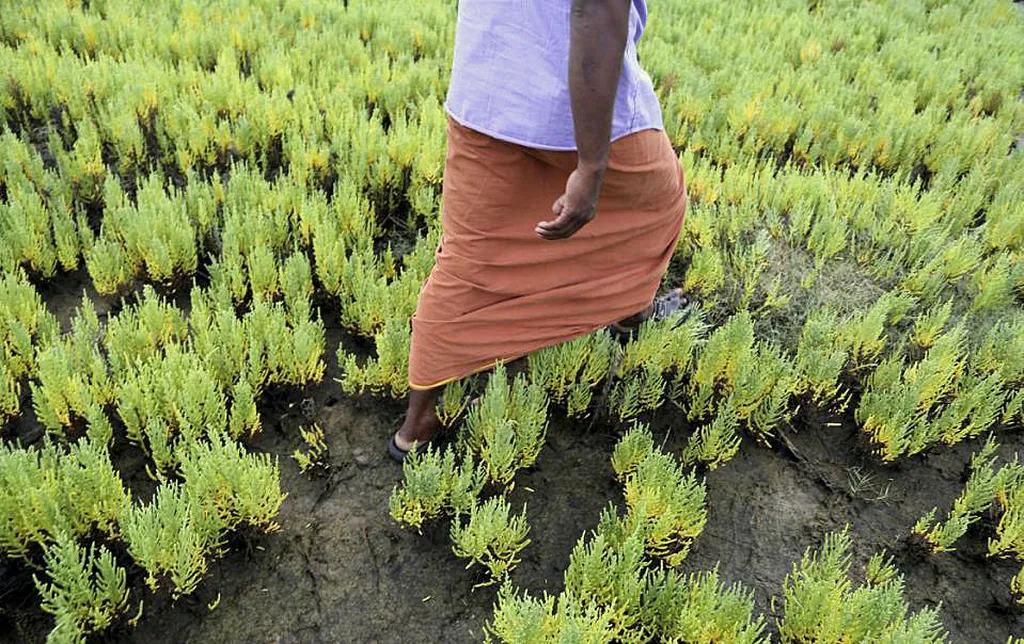
In the face of climate change and the increasing salinization of arable land, scientists are turning to halophytes—salt-tolerant plants—to uncover strategies for sustainable agriculture. A recent study published in *Scientific Reports* sheds light on how *Salicornia europaea*, a hardy halophyte, adapts to salinity stress, offering promising insights for biotechnological applications.
The research, led by Stefany Cárdenas Pérez from the Department of Geobotany and Landscape Planning at Nicolaus Copernicus University in Toruń, explores how increasing concentrations of NaCl (0, 200, 400, and 1000 mM) alter the composition and mechanical behavior of key cell wall polymers: cellulose, pectin, and lignin. Using advanced techniques such as atomic force microscopy (AFM), fluorescence-based imaging, pectin immunolocalization, and polarized light microscopy, the team demonstrated that salinity drives tiered changes in polymer deposition and stiffness.
At optimal salinity levels (200–400 mM), the cell walls of *S. europaea* exhibited softening, linked to reduced cellulose deposition and increased pectin methylesterification. This adaptation facilitates turgor maintenance and cell expansion, crucial for plant growth under saline conditions. “The shift in lignin composition toward syringyl-rich polymers is particularly interesting,” noted Cárdenas Pérez. “It promotes elasticity and enhances apoplastic water flow, which could be beneficial for plant-based applications.”
However, at extreme salinity (1000 mM), the cell walls showed reduced flexibility and altered lignin monomer profiles, favoring p-hydroxyphenyl units. This shift is seen as a cost-saving adaptation, highlighting the plant’s ability to optimize its resources under stress.
The study’s findings provide a mechanistic framework for optimizing cell wall composition in *S. europaea* to enhance its functional value. By mapping polymer-specific responses to salinity, the research supports the targeted cultivation of halophytes for various applications, including functional foods, plant-based therapeutics, and more efficient biofuel feedstocks.
The commercial implications for the agriculture sector are significant. As arable land becomes increasingly saline, understanding and leveraging the adaptations of halophytes like *S. europaea* could open new avenues for sustainable crop production. “This research not only advances our understanding of plant biology but also paves the way for innovative agricultural practices,” said Cárdenas Pérez.
The study’s insights into cell wall remodeling and nanomechanics could shape future developments in plant biotechnology, offering strategies for enhancing crop resilience and productivity in saline environments. As the world grapples with the challenges of climate change, such research is invaluable for developing sustainable solutions for the future of agriculture.