
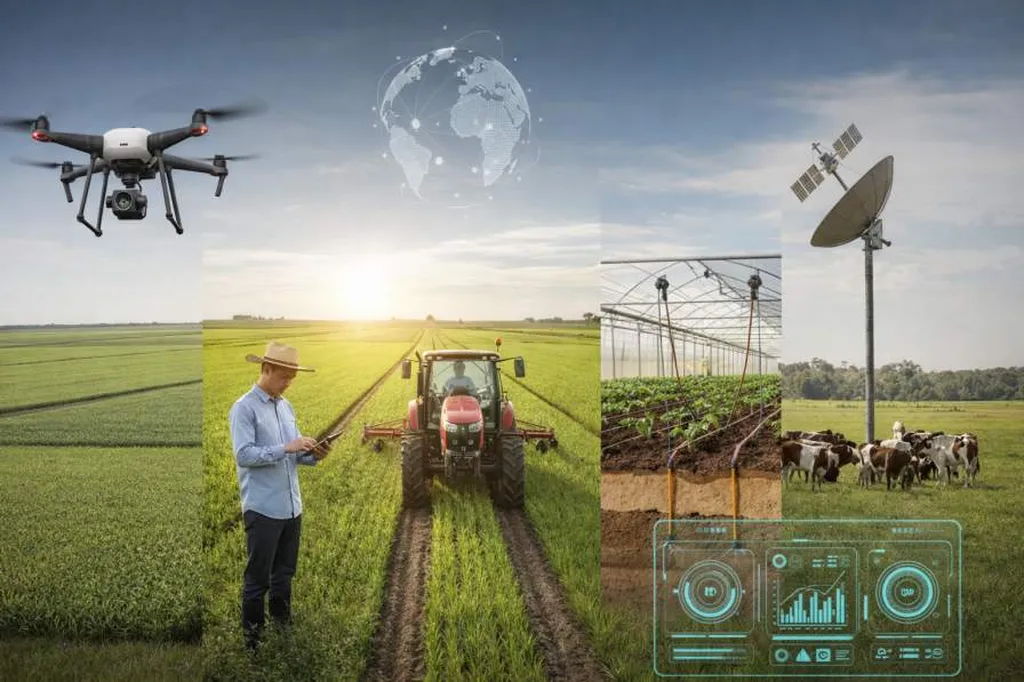
In the heart of India’s agricultural landscape, a silent revolution is brewing, one that promises to reshape the way farmers access machinery and ultimately, secure the nation’s food future. The Custom Hiring Centers (CHCs), a network of hubs offering farm machinery on rent, are poised to become smarter, more efficient, and more transparent, thanks to a pioneering research framework proposed by Nandigam Harish from the College of Technology and Engineering at Maharana Pratap University of Agriculture and Technology. The study, published in ‘Discover Internet of Things’, suggests that integrating Internet of Things (IoT), Artificial Intelligence (AI), and Machine Learning (ML) technologies into CHCs could significantly enhance their operations and impact.
India’s agricultural sector, a vital cog in the nation’s food security wheel, is grappling with a conundrum. With farm electricity availability standing at 3.045 kW/ha and over 85% of farmers being small or marginal, the dream of owning expensive machinery often remains just that—a dream. CHCs, with their promise of affordable, on-demand access to machinery, are a beacon of hope. Yet, they face challenges like peak-season shortages, lack of skilled operators, and inefficient scheduling.
Harish’s research proposes a real-time monitoring framework that could turn the tide. “By integrating sensor-based real-time monitoring and digital platforms, we can enhance machinery utilization, predictive maintenance, operator efficiency, and financial transparency,” Harish explains. This tech-driven approach could reduce downtime, improve accessibility, and lower operational costs, strengthening the sustainability of CHCs.
The commercial impacts of this research could be profound. For one, it could accelerate the pace of farm mechanization, a critical need given India’s burgeoning population and food demand. By 2024-2025, the establishment of 26,662 CHCs is expected to bridge the machinery access gap. But the real game-changer could be the integration of digital technologies, making these centers more efficient and farmer-friendly.
Moreover, the proposed framework aligns with several government schemes like NMAM, NICRA, SMAM, NFSM, RKVY, and MIDH, offering a cost-effective and sustainable pathway for farm mechanization. The research underscores the potential of IoT- and AI-enabled systems to revolutionize CHCs, making them a cornerstone of India’s agricultural future.
As we stand on the brink of this digital agricultural revolution, one thing is clear: the future of farming is not just about plows and tractors, but about data, algorithms, and real-time monitoring. And with researchers like Harish leading the charge, the future looks promising indeed. The proposed framework, if implemented, could set a new benchmark for farm mechanization, not just in India, but globally. It’s a testament to the power of technology to transform traditional sectors and pave the way for a more efficient, sustainable, and food-secure future.