
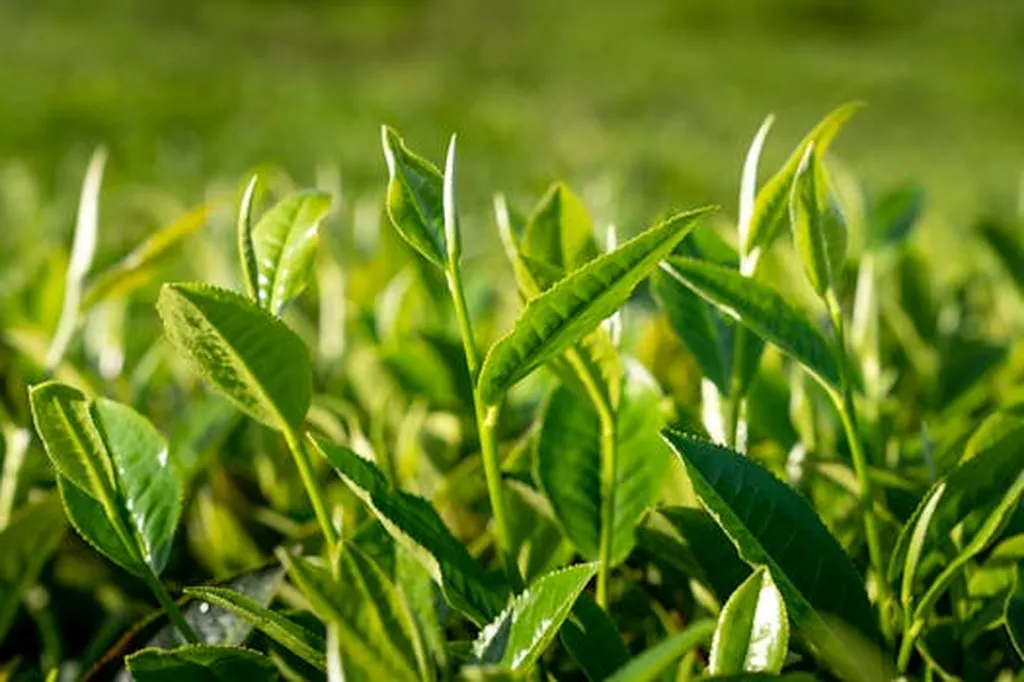
In the heart of Japan, researchers have unlocked a new method to optimize chlorophyll content prediction in tea leaves, a breakthrough that could reshape precision agriculture and boost the agricultural sector’s efficiency. The study, led by Yuta Tsuchiya from the Graduate School of Science and Technology at Shizuoka University, was recently published in *BMC Plant Biology*.
The research team employed four machine learning models—1D Convolutional Neural Network (1D-CNN), Self-Supervised Learning (SSL), Vision Transformer (ViT), and Conformer—to analyze spectral reflectance data from tea leaves (Camellia sinensis). The goal was to understand how different preprocessing techniques could enhance the accuracy of chlorophyll content prediction.
The team tested four preprocessing techniques: Original Reflectance (OR), Continuum Removal (CR), De-trending (DT), and Standard Normal Variate (SNV). Each method had a unique impact on the spectral data. SNV and DT enhanced spectral sensitivity to chlorophyll content, particularly around the absorption regions of 450–500 nm and 650–700 nm. In contrast, CR emphasized negative correlation in the visible spectrum.
The results were striking. The SSL model combined with SNV preprocessing achieved the highest accuracy, with an R² value of 0.82 and an RPD of 2.37. This combination outperformed other model-preprocessing pairs, demonstrating the potential of tailored preprocessing strategies in hyperspectral analysis.
“Our findings highlight the importance of choosing the right preprocessing method for each machine learning model,” Tsuchiya explained. “The optimal preprocessing technique can significantly enhance prediction performance, which is crucial for monitoring plant physiological status and supporting precision agriculture.”
The study also revealed that different models benefited from different preprocessing techniques. The 1D-CNN model performed best with DT, leveraging local spectral features, while ViT and Conformer models showed improved performance with CR, which emphasizes absorption depth and spectral shape.
This research could have profound implications for the agricultural sector. Accurate chlorophyll estimation is essential for monitoring plant health and optimizing crop management practices. By improving the precision of chlorophyll content prediction, farmers can make more informed decisions about irrigation, fertilization, and pest control, ultimately enhancing crop yields and sustainability.
As the agricultural industry continues to embrace technology, the integration of machine learning and spectral analysis could revolutionize plant phenotyping. “The future of agriculture lies in the intersection of data science and agronomy,” Tsuchiya noted. “By leveraging advanced machine learning models and spectral preprocessing techniques, we can unlock new insights into plant physiology and drive innovation in precision agriculture.”
The study published in *BMC Plant Biology* underscores the importance of customized preprocessing strategies for hyperspectral analysis and provides practical insights for improving biochemical trait estimation in plant phenotyping. As researchers continue to explore the potential of machine learning in agriculture, this breakthrough could pave the way for more efficient and sustainable farming practices.