
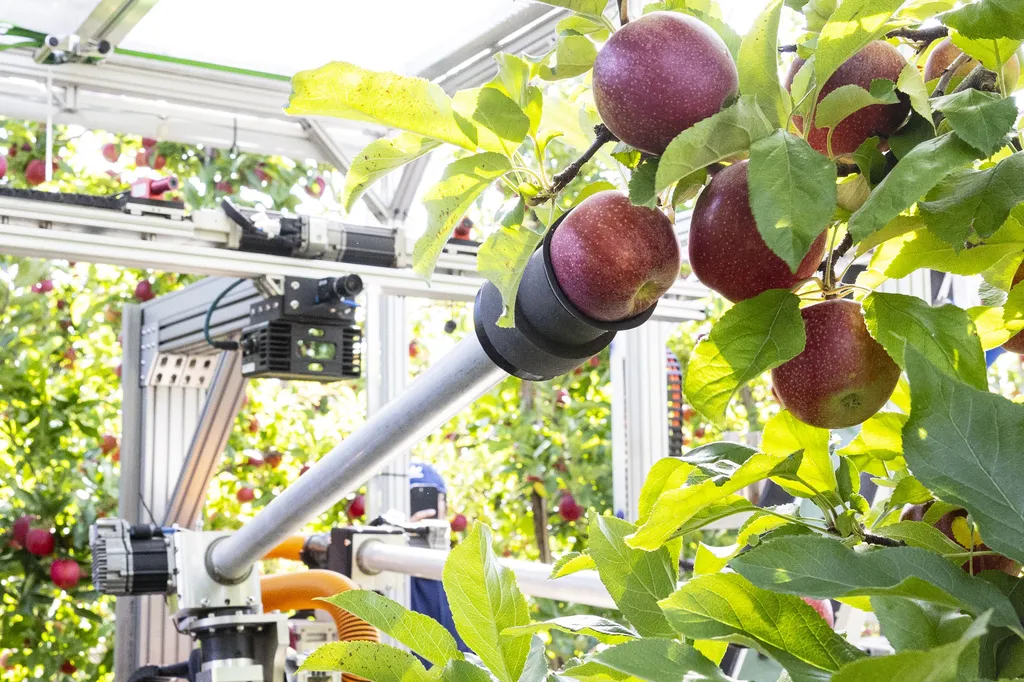
In the heart of modern agriculture, where technology and tradition intersect, a new breakthrough is poised to revolutionize the way we approach apple harvesting. Researchers have developed LPNet, a lightweight progressive network designed to tackle the complex challenges of pose estimation in orchard environments. This innovation, published in *Artificial Intelligence in Agriculture*, could significantly enhance the efficiency and accuracy of robotic apple harvesting, a critical need for the agriculture sector.
The study, led by Wenbei Wang from the State Key Laboratory of Agricultural Equipment Technology at the Chinese Academy of Agricultural Mechanization Sciences Group Co., Ltd, introduces a novel approach to apple pose estimation. LPNet employs a Calyx-Aware Labeling Strategy (CALS) to improve annotation quality, an improved ShuffleNetV2 backbone with progressive channel expansion, and integrates Content-Aware ReAssembly of FEatures (CARAFE) with Bi-directional Feature Pyramid Network (BiFPN) in the neck. This combination enables compact yet expressive multi-scale feature processing, crucial for navigating the intricate environments of orchards.
One of the standout features of LPNet is its Axis-Aligned Soft Geometric Constraint (ASGC), which reinforces spatial symmetry and training stability through geometry-aware learning. This innovation allows the network to predict five calyx-centric keypoints, which are then processed through a geometric solver to determine the apple’s 2D orientation for harvesting guidance.
The implications for the agriculture sector are profound. “LPNet achieves an effective trade-off between accuracy and efficiency, laying a solid foundation for the future development of practical vision systems in autonomous apple harvesting robots,” Wang explains. The network’s ability to achieve 93.6% [email protected] at a low computational cost of only 22.2 GFLOPs, while maintaining a high inference rate of 158.7 FPS, outperforms representative models such as YOLOv12m-pose, HRFormer, and RTMPose.
This research not only addresses the immediate need for more efficient and accurate pose estimation in orchard environments but also paves the way for future developments in agricultural robotics. As the industry continues to evolve, the integration of advanced machine vision and deep learning technologies will be crucial in meeting the demands of modern agriculture.
The study, published in *Artificial Intelligence in Agriculture* and led by Wenbei Wang from the State Key Laboratory of Agricultural Equipment Technology, represents a significant step forward in the field of agricultural robotics. By providing a robust and efficient solution for apple pose estimation, LPNet sets a new standard for the industry, offering a glimpse into the future of autonomous harvesting and the broader applications of AI in agriculture.