
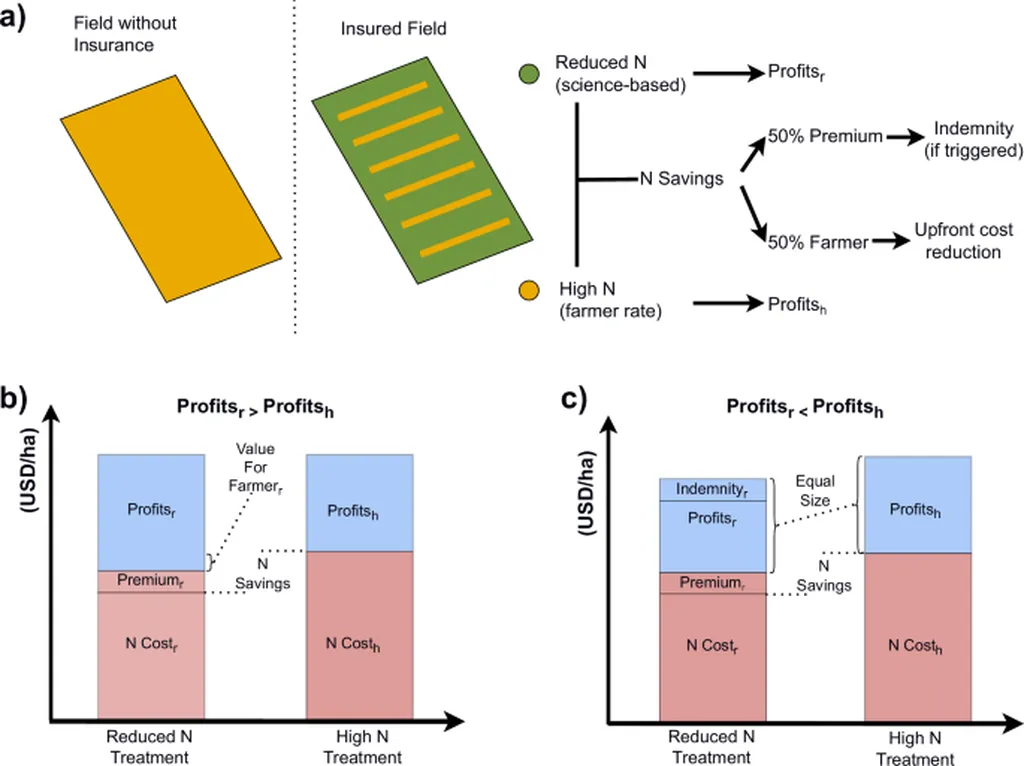
In the heart of the Midwest, a novel approach to nitrogen management in maize farming is stirring up a conversation that could reshape the agricultural landscape. Researchers have unveiled a market-based nitrogen insurance concept that not only promises to bolster farmers’ profits but also significantly reduce environmental impacts. This innovative strategy, published in *Communications Earth & Environment*, could mark a turning point in the ongoing quest to balance economic viability with ecological responsibility.
The study, led by German Mandrini from the Department of Agronomy at Purdue University, leverages a comprehensive dataset encompassing 4270 maize fields in Illinois, over three decades of weather data, and 33 different fertilizer rates. The findings are compelling: farmers who apply excess nitrogen fertilizer can reduce their usage without financial risk, thanks to this insurance mechanism. “This approach is a win-win,” Mandrini explains. “It aligns the interests of farmers, insurers, and the environment in a way that hasn’t been possible before.”
The economic implications are substantial. Farmers applying at least 40 kilograms of nitrogen per hectare above recommended rates stand to gain an average of $14 per hectare annually. Insurers, too, see a profit of around $10 per hectare. When scaled across eligible maize areas in Illinois, the insurance could annually reduce nitrate leaching by 31% and cut greenhouse gas emissions by 682,000 metric tonnes of carbon dioxide equivalent.
The commercial impact of this research is profound. For the agriculture sector, it offers a viable pathway to sustainable nitrogen management, a critical issue given the growing demand for maize and the environmental costs of excessive fertilizer use. “This isn’t just about reducing emissions; it’s about creating a sustainable business model that farmers can adopt without sacrificing profitability,” Mandrini notes.
The potential for scalability is another key aspect of this research. While the study focuses on maize in Illinois, the principles could be extended to other nitrogen-intensive crops and regions. This adaptability makes the approach globally relevant, offering a blueprint for reconciling farm profitability with environmental stewardship.
As the agricultural sector grapples with the challenges of climate change and sustainability, this market-based insurance approach provides a beacon of hope. It demonstrates that economic and environmental goals are not mutually exclusive but can be harmonized through innovative thinking and strategic planning. The research, published in *Communications Earth & Environment* and led by German Mandrini from Purdue University’s Department of Agronomy, could well be the catalyst for a new era in sustainable agriculture.