
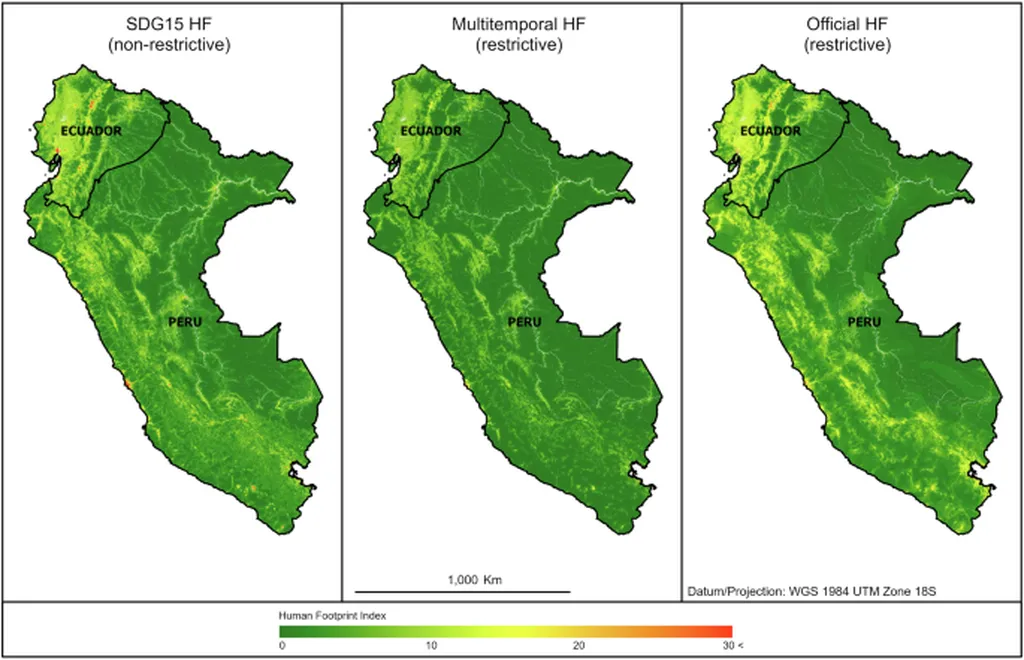
In a significant stride towards understanding and mitigating human impact on biodiversity, researchers have unveiled the first comprehensive national human footprint maps for Peru and Ecuador. Published in *Scientific Data*, this groundbreaking study integrates multiple human pressures into a single spatial index, offering a nuanced view of ecosystem naturalness and its implications for agriculture and conservation.
The research, led by Jose Aragon-Osejo of the Natural Resources and Environmental Studies Institute at the University of Northern British Columbia, provides a historical series of human footprint (HF) maps for both countries. These maps, spanning from 2012 to 2021 for Peru and 2014 to 2022 for Ecuador, incorporate data from built environments, land use/land cover (including agriculture, pasture, and tree plantations), roads and railways, population density, electrical infrastructure, oil and gas infrastructure, and mining.
The detailed mapping of human pressures offers invaluable insights for the agriculture sector. By identifying areas with high human influence, farmers and policymakers can make informed decisions about land use, potentially optimizing agricultural practices while minimizing environmental impact. “These maps are a game-changer for sustainable agriculture,” says Aragon-Osejo. “They allow us to see where human activities are most intense and how they might be affecting biodiversity, which is crucial for maintaining healthy ecosystems that support agriculture.”
The study also highlights the importance of monitoring and modeling biodiversity. By understanding the spatiotemporal patterns of human influence, stakeholders can better plan conservation efforts and mitigate the negative impacts of agricultural expansion. “The maps provide a clear picture of how human activities are shaping the landscape,” explains Aragon-Osejo. “This information is vital for developing strategies that balance agricultural productivity with environmental conservation.”
The commercial implications for the agriculture sector are substantial. With a clearer understanding of human footprint patterns, companies can invest in sustainable practices that not only enhance productivity but also protect natural resources. This dual focus on profitability and sustainability is increasingly important in a world grappling with climate change and biodiversity loss.
Looking ahead, this research sets the stage for future developments in the field. By providing a robust framework for assessing human impact, the study paves the way for more targeted and effective conservation efforts. It also underscores the need for continued monitoring and data collection to track changes over time and adapt strategies accordingly.
As the world seeks to achieve Sustainable Development Goal 15—life on land—these maps offer a critical tool for measuring progress and guiding policy. With the leadership of researchers like Jose Aragon-Osejo and the support of institutions like the Natural Resources and Environmental Studies Institute at the University of Northern British Columbia, the future of sustainable agriculture and conservation looks increasingly promising.