
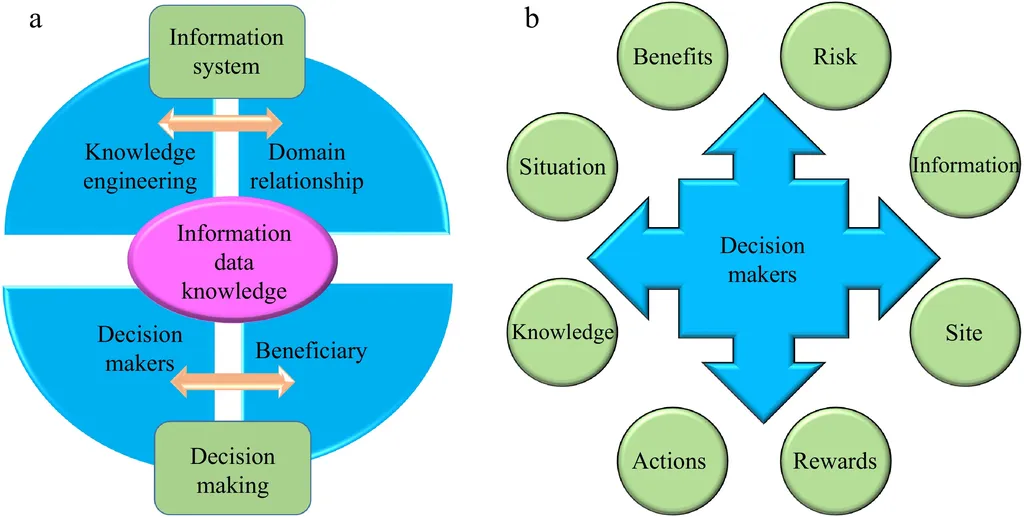
In the ever-evolving landscape of agriculture, where economic, environmental, and social factors intertwine to create a complex web of challenges, decision-makers are often left grappling with uncertainty. A recent study published in *Scientific Reports* offers a novel approach to tackle these multi-faceted problems, potentially revolutionizing how we evaluate sustainable agriculture strategies.
The research, led by Yanfeng Yu from the Institute of Agricultural Economics and Information at the Jiangxi Academy of Agricultural Sciences, introduces a new multi-criteria decision-making (MCDM) model based on complex circular intuitionistic fuzzy sets (CCIRIFSs). This innovative framework synergistically combines circular intuitionistic fuzzy sets and complex numbers to address directional periodicity and two-dimensional uncertainties, providing a robust tool for decision-making in the agricultural sector.
The study presents two new operators, the complex circular intuitionistic fuzzy Dombi weighted averaging (CCIRIFDWA) and geometric (CCIRIFDWG) operators, which enhance aggregation performance. These operators, built on parameterized Dombi t-norms and t-conorms, possess mathematical properties such as idempotency, boundedness, and monotonicity, ensuring rigorous and flexible processing of imprecise data.
The practical implications of this research are profound. As Yanfeng Yu explains, “Our model provides a mathematically complete and context-specific decision-making approach for cyclic, uncertain agricultural systems. It can help stakeholders evaluate sustainability approaches across different criteria, ultimately leading to more informed and effective decision-making.”
The case study within the research focuses on sustainable agriculture, demonstrating the framework’s effectiveness. The results showed that greenhouse farming under a controlled environment emerged as the best strategy, with scores of 0.874 for CCIRIFDWA and 0.861 for CCIRIFDWG. This indicates the model’s strong and flexible nature, offering valuable insights for commercial agriculture.
The potential commercial impacts of this research are significant. By providing a more accurate and comprehensive evaluation of sustainable agriculture strategies, the model can help farmers and agribusinesses make decisions that balance economic viability, environmental sustainability, and social responsibility. This could lead to increased productivity, reduced environmental impact, and improved profitability, ultimately shaping the future of the agriculture sector.
Moreover, the research opens up new avenues for the application of fuzzy methodologies and decision support systems in agriculture. As the field continues to evolve, the integration of advanced mathematical models like CCIRIFSs could become a standard practice, enabling more precise and adaptive decision-making in the face of uncertainty.
In conclusion, this study represents a significant step forward in the application of complex circular intuitionistic fuzzy sets in agricultural decision-making. By offering a novel framework that addresses the complexities and uncertainties inherent in the sector, it paves the way for more sustainable and profitable agricultural practices. As the agriculture industry continues to grapple with multifaceted challenges, the insights and tools provided by this research will be invaluable in navigating the path towards a more sustainable future.