
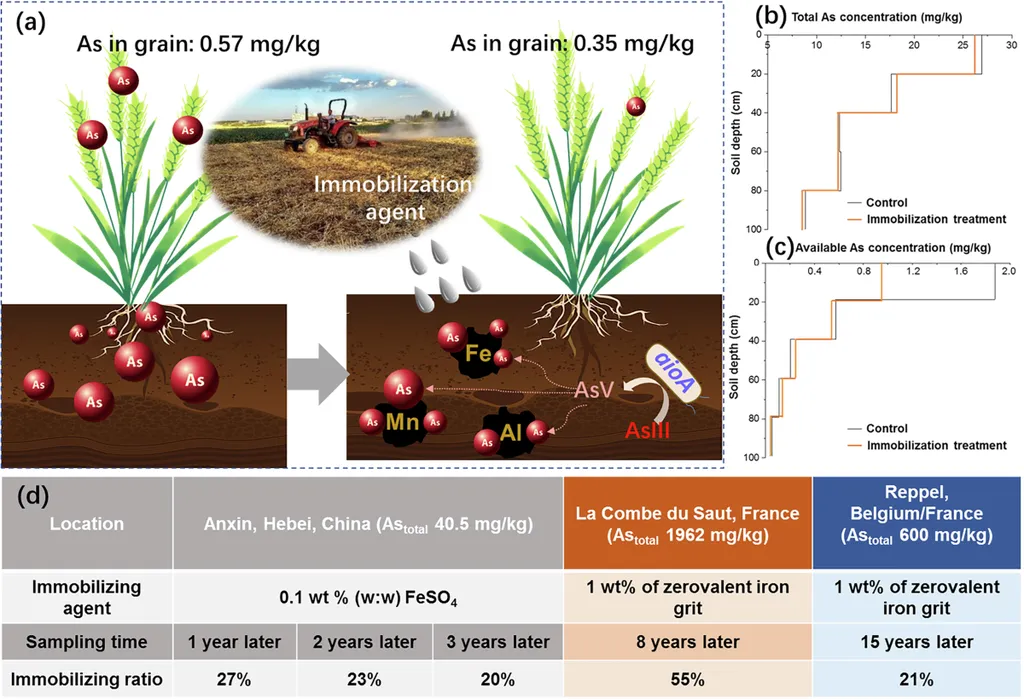
In the heart of agricultural innovation, a new study is challenging conventional wisdom on how to handle arsenic-contaminated soil, offering a glimmer of hope for farmers and food safety advocates alike. Published in *npj Sustainable Agriculture*, the research, led by Xiaoming Wan of the Institute of Geographic Sciences and Natural Resources Research at the Chinese Academy of Sciences, revisits the age-old question: should we concentrate or dilute arsenic in contaminated agricultural soils?
Arsenic, a naturally occurring element, is a silent menace that can seep into soil and water, posing significant risks to food safety and environmental health. Unlike organic pollutants that can be broken down, arsenic is non-degradable, meaning it simply shifts between environments. “The Earth’s arsenic amount remains constant,” explains Wan. “This raises a critical question: should we focus on diluting it or concentrating it?”
To find answers, Wan and his team analyzed data from approximately 30 agricultural soil remediation projects worldwide, with some operations running for up to 15 years. They categorized the remediation technologies into three scenarios based on their impact on arsenic distribution: concentration, dilution, and no change. The study then evaluated the effects of these scenarios on food safety, soil arsenic concentration, and bioavailability.
The findings are promising. Post-remediation, agricultural produce from these soils consistently met national safety standards. Moreover, the study suggests that dilution could be a viable alternative to concentration or no-change approaches, particularly for soils with low arsenic contamination. “Dilution could be a game-changer,” Wan notes, “offering a more sustainable and potentially cost-effective solution for farmers.”
The commercial implications for the agriculture sector are substantial. Traditional remediation methods often involve expensive and labor-intensive processes to concentrate and remove arsenic. Dilution, on the other hand, could offer a simpler, more scalable solution. This could lead to reduced costs for farmers, increased crop yields, and enhanced food safety, ultimately benefiting consumers and the economy.
Looking ahead, this research could shape future developments in soil remediation technologies. By advocating for a shift towards dilution strategies, the study opens new avenues for innovation in agricultural practices and environmental management. As the global population grows and food demand increases, ensuring the safety and sustainability of our agricultural soils becomes ever more critical.
In the words of Wan, “This is not just about cleaning up our soils; it’s about securing our future.” With further research and real-world testing, dilution-based remediation could become a cornerstone of sustainable agriculture, offering a brighter, safer future for farmers and consumers alike.